In brief
- The ASUS Turbo Radeon AI Pro R9700 has 32 GB of GDDR6 memory and 640 GB/s of memory bandwidth.
- The card’s total board power is 300 W, and its design occupies two expansion slots.
- Display outputs comprise three DisplayPort 2.1a ports and one HDMI 2.1b port.
- Software ECC support is available only on Linux and must be enabled manually.
ServeTheHome covered the ASUS Turbo Radeon AI Pro R9700 workstation card in a review published on 24 November 2026. Based on AMD’s Navi 48 GPU, the card stands out for its 32 GB of GDDR6 memory and dual-slot design, intended to support multiple cards in a single system. The review details the card’s hardware and physical design, but does not provide performance benchmarks for architecture software or rendering workloads.
Designed for multi-card configurations
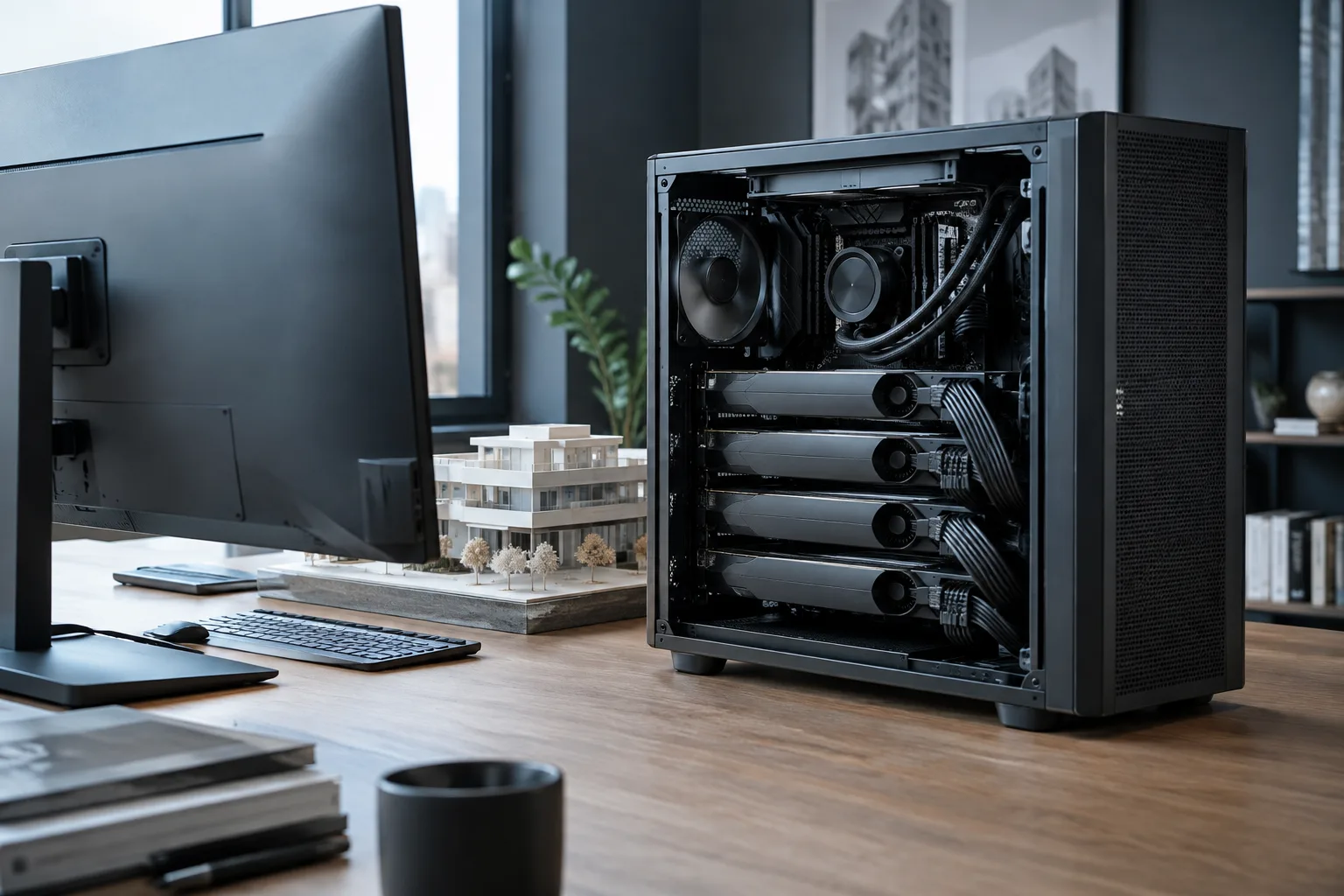
ASUS’s card uses a PCIe Gen5 x16 interface and measures 267 × 111 × 40 mm. Its blower-style cooling design fits within a two-slot form factor. According to the review, this approach is intended to make it easier to install multiple cards in a workstation. ASUS says the fans use dual ball bearings.
The power connector is an ATX 12V-2×6 socket positioned at the rear of the card rather than along its top edge. Total board power is rated at 300 W, while the power connector supports up to 600 W. These are factors to consider when planning a system’s internal layout and power requirements. The review notes that a four-card system may be possible, but does not measure performance in any specific workload for such a setup.
Navi 48 and 32 GB of GDDR6
The Navi 48 GPU is based on the RDNA 4 architecture. The ASUS Turbo Radeon AI Pro R9700 has 64 compute units and 128 AI accelerators for matrix operations. The GPU’s boost clock is 2.92 GHz; peak performance figures cited from the manufacturer are 382.7 TFLOPS for FP8 matrix operations and 47.8 TFLOPS for FP32 vector operations.
The card’s 32 GB of GDDR6 memory runs at 20 Gbps over a 256-bit memory interface. The review lists bandwidth at 640 GB/s. ECC support is limited to Linux; the review also notes that it is not enabled automatically and must be switched on manually. For systems that require additional protection against memory errors, checking the card’s spec sheet alone is therefore not enough—the operating system and configuration also need to be verified.
Display outputs and screen support
The card has three DisplayPort 2.1a outputs and one HDMI 2.1b output. ServeTheHome reports that the card can drive displays at resolutions up to 12K when Display Stream Compression (DSC) is used. For design teams working with multiple displays, these connections may be worth considering when planning a display setup; however, the source provides no details on specific display combinations or compatibility with professional applications.
What does it mean for architecture and visualization workflows?
The 32 GB of memory is one of the card’s notable features for teams working with large datasets or considering running AI workloads on a workstation. Its physical design, suited to multi-card installations, may also appeal to technical teams planning to use multiple accelerators in a single system. However, the review includes no comparative results for 3D modeling, real-time visualization or rendering software. Architecture and archviz teams should therefore avoid assuming how the card will perform in their own applications.
The review describes AMD and its partners’ positioning of the card as a more budget-friendly alternative to the NVIDIA RTX PRO Blackwell series; the only pricing information given is that it costs under $2,000. The source does not specify a price or release date for Turkey, or compatibility with specific software. When evaluating a purchase, consider the card’s 300 W power requirement, its two-slot footprint and its Linux-dependent ECC requirements together.
Sources
1 sourceSource texts are not republished; short quotes are marked, everything else is our own summary and commentary.
For architecture and visualization offices in Turkey, the R9700’s clearest appeal is its 32 GB of memory and design suited to using multiple cards in a workstation. These features alone, however, do not show that modeling or rendering software will run faster; the review includes no benchmarks for those applications.
The 300 W board power, case layout and ECC—which must be enabled manually on Linux—should all factor into a purchase decision. The under-$2,000 price does not represent the price in Turkey, so it is not possible to calculate the total cost until local availability and licensing terms are clear. Software compatibility should also be verified separately.
Frequently asked questions
How much memory does the ASUS Turbo Radeon AI Pro R9700 have?
The card has 32 GB of GDDR6 memory. The review lists memory bandwidth at 640 GB/s.
How much power does the ASUS Turbo Radeon AI Pro R9700 use?
The review specifies total board power of 300 W.
How does ECC support work on the Radeon AI Pro R9700?
Software ECC support is available only on Linux and must be enabled manually.