In brief
- After Night There Is Nothing was designed by Mohamad Nahleh and Ozayr Saloojee.
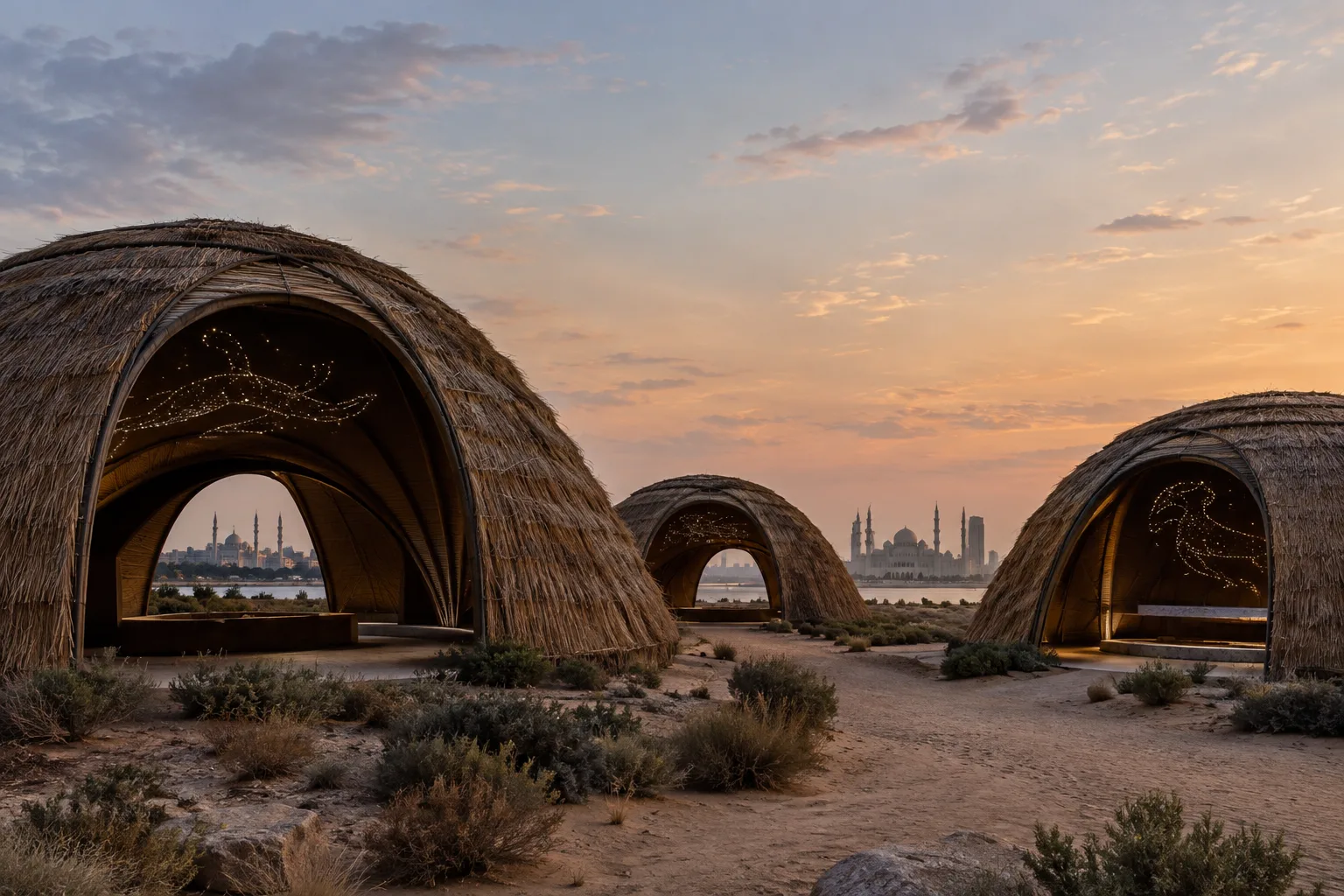
- Curved structures made of wood and steel are covered with reed; their inner surfaces feature constellation drawings inspired by military objects.
- The installations are on view at Al Qasimiyah School, a former slaughterhouse, and the town of Al Madam.
- The Sharjah Architecture Triennial runs at various venues from 14 November 2026 to 14 April 2027.
After Night There Is Nothing, a three-part installation designed by architect Mohamad Nahleh and architecture professor Ozayr Saloojee, is on view in Sharjah, United Arab Emirates, as part of the Sharjah Architecture Triennial, which opened on 14 November 2026. The domed structures, made of wood and steel and clad in reed, focus on a night sky transformed by drones, satellites, rockets, and missiles.
Three-part shell, sections of a giant sphere
The installations consist of three curved shells, conceived by the designers as sections of a giant sphere. Vinyl covering their inner surfaces features creature-like constellations inspired by military objects. In this way, the work treats the sky not simply as a realm defined by stars, but as a place where technological objects intersect with the meanings communities attach to them.
Nahleh and Saloojee also designed the structures as living forms reminiscent of the Solifugae spider, which emerges at night. The project aims to bring the reality of modern warfare together with myth and storytelling. The designers’ research draws on how communities exposed to military attacks over long periods interpret these objects.
Different perspectives across three sites
The shells are spread across three venues of the Sharjah Architecture Triennial: Al Qasimiyah School, a former slaughterhouse, and the sandy town of Al Madam. Each structure has three openings cut through its shell. The vertical cut in Al Madam frames the minaret of a distant mosque. The long opening at the former slaughterhouse is positioned in relation to the height of a cow.
Rather than completely enclosing their surroundings, these cuts foreground specific views and scales. The meaning of each space is shaped not only by the shell’s form, but also by the surroundings visible through its openings and the installation’s location. Traditional Hakawati storytellers telling tales inside the installations as part of the Triennial also bring oral storytelling into the work’s spatial experience.
What does it mean for architecture and visualization?
The work offers a concrete example of how architectural form can carry a narrative: the reed-clad outer shell, the drawings on the inner surface, the orientation of the openings, and the surroundings at each location have all been considered together. For architecture and interior architecture students, it offers a chance to examine how the relationship between a recurring form and its context changes across different sites. Archviz artists can also consider the framing of the openings, the contrast between interior and exterior materials, and the way specific features such as a minaret are framed as tools for visual storytelling.
These are themes for representation and spatial interpretation that can be drawn from the design decisions described in the source; no information is provided about the modeling or rendering software used for the project. The work is an architectural installation presented in different contexts, not an announcement about digital production techniques or software features. The Triennial continues at various Sharjah venues until 14 April 2027.
Sources
1 sourceSource texts are not republished; short quotes are marked, everything else is our own summary and commentary.
A strength of After Night There Is Nothing is how it uses a single shell form in three different contexts while establishing a different visual relationship at each site. For architecture firms and visualization teams, it is a useful reminder that site selection, as much as material and form, can be part of the narrative. The opening framing the minaret in Al Madam makes the approach of keeping the surroundings integral to the design especially clear.
Teams in Turkey considering a similar project should avoid making assumptions about costs, construction details, or building conditions that are not specified in the source. What stands out here is not any particular hardware or software, but the way material, section, and context are considered together. As no information is provided about the project’s digital production tools, it is not possible to draw conclusions about its technical workflow.
Frequently asked questions
Where is After Night There Is Nothing on view?
The installation is on view as part of the Sharjah Architecture Triennial at Al Qasimiyah School, a former slaughterhouse, and in the town of Al Madam.
What materials make up the installation?
The three curved structures are made of wood and steel. Their exteriors are covered in reed, while their inner curves are clad in vinyl.
How long does the Sharjah Architecture Triennial run?
The Triennial takes place at various venues in Sharjah from 14 November 2026 to 14 April 2027.