In brief
- Since 10 September 2026, FLUX 3 Video has supported qhd (2K) and uhd (4K) resolution options.
- 4K text-to-video and image-to-video generation costs $0.80 per second, while 2K costs $0.40.
- The model generates videos with synchronized audio at 24 fps, up to 20 seconds per request.
- The open-weight FLUX 3 Dev version is expected in 2026 but has not yet been released.
On 10 September 2026, Black Forest Labs (BFL) added 2K and 4K output support to the FLUX 3 Video API. The resolution parameter at the POST /v1/flux-3-video endpoint now accepts qhd (2560 × 1440 at 16:9) and uhd (3840 × 2176 at 16:9). The update is one of the most significant steps for the video side of the FLUX 3 family, announced in July and made generally available in early August.
What is FLUX 3 Video?
On 23 July 2026, BFL introduced FLUX 3 as “a single multimodal foundation model jointly trained on image, video, and audio.” The company had previously become known especially for image generation with FLUX.1 and FLUX.2; with FLUX 3, it has moved into video and audio. At launch, the model was available only through an application-based early access program.
Video generation became generally available through the API on 4 August. At that stage, the model could generate videos with synchronized audio at 24 frames per second, up to 20 seconds long, at Full HD resolution (1920 × 1088 at 16:9) in a single request. The endpoint offers four modes:
Text-to-video (t2v)
Image-to-video with interpolated frames (i2v)
Video continuation (v2v): up to 15 seconds since 17 August
Draft enhancement (
draft_enhance): creates a high-quality final version of a draft output
How do 2K and 4K work, and what do they cost?
BFL's release notes include an important technical detail: all resolution tiers above hd run the same generation; the only difference is the canvas size processed by the video upsampler. In other words, selecting 4K does not change the scene's composition or motion—it processes the same generation at a higher resolution. Higher resolutions can also be used with the draft_enhance mode.
Prices per second of output are as follows:
| Mode | QHD (2K) | UHD (4K) |
|---|---|---|
| Text-to-video | $0.40/sec | $0.80/sec |
| Image-to-video | $0.40/sec | $0.80/sec |
| Video continuation | $0.65/sec | $0.95/sec |
At these rates, a 20-second 4K image-to-video clip costs $16, while the same clip in 2K costs $8. BFL also released a separate FLUX Video Upscale endpoint on 20 August. The tool upscales existing clips to between 1.5 and 3 times their source resolution; it accepts clips up to 20 seconds long, 50 MB in size, and with an input resolution of 2560 × 1440. The precision mode costs $0.07 per megapixel-second, while the creative mode is priced at $0.10.
What does this mean for architectural visualization?
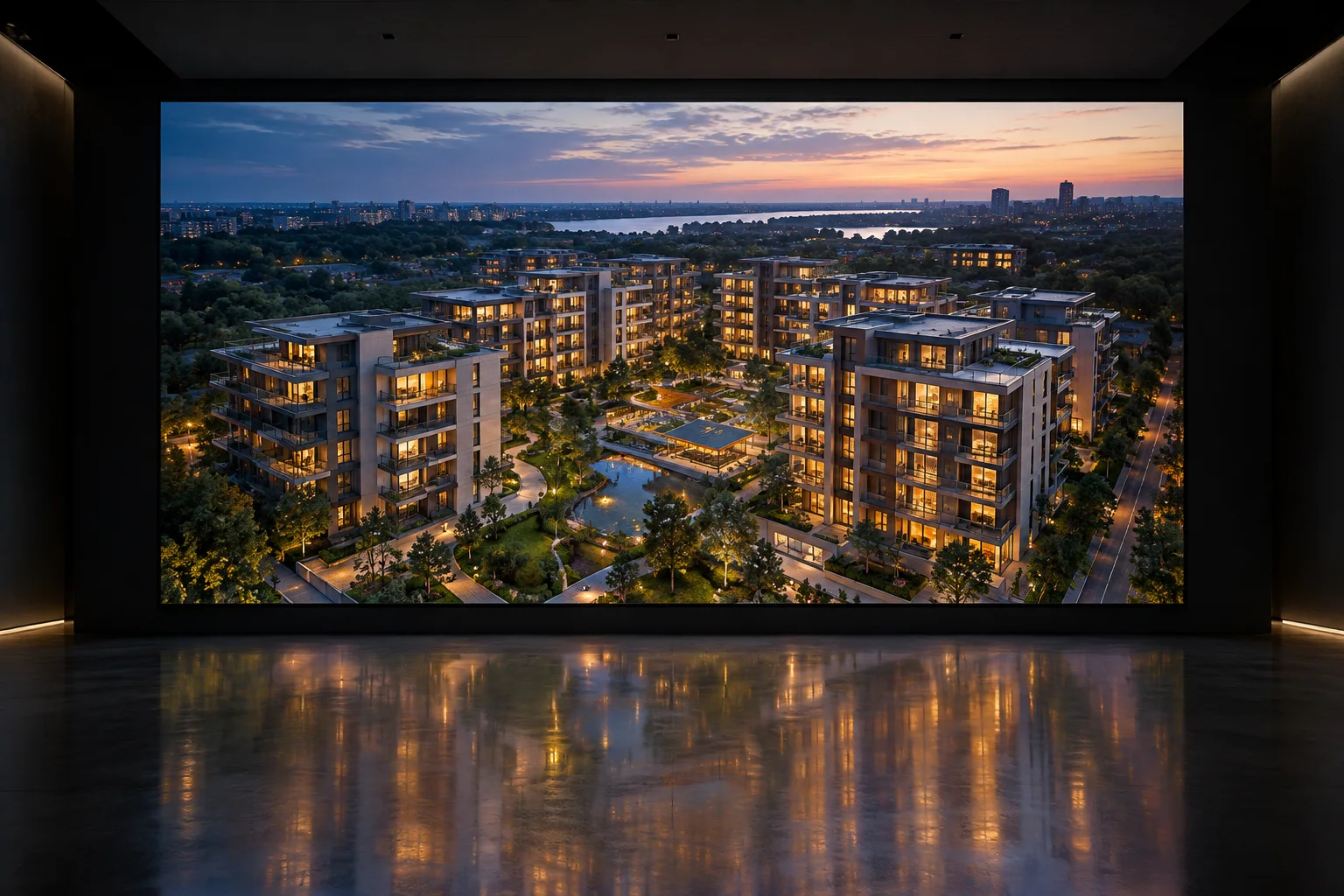
Resolution has been one of the main objections archviz studios have had to video models. 1080p is often insufficient for client presentations, large screens in sales offices, and project films, while 4K delivery has become almost standard in the industry. FLUX 3 Video's ability to output 4K directly brings an animated frame from a render engine closer to the delivery format, without requiring an additional upscaling step.
The image-to-video mode with interpolated frames is also useful for architectural work. Offices can use their own renders as anchor frames to create atmospheric clips, such as a facade sequence with changing light, an interior with moving curtains, or wind effects in a landscape. Synchronized audio generation also offers an additional source of ambient sound for promotional films.
Still, it's worth keeping in mind that, according to the release notes, the 4K tier is an upscaled version of the same generation. Distortions in geometry during motion or in straight lines won't be fixed by resolution alone. So for sequences that require precision in dimensions and proportions, it's more realistic to rely on conventional render animation and treat FLUX 3 Video as a complementary tool for atmospheric and promotional clips.
When will open weights be available?
In its July announcement, BFL said the open-weight FLUX 3 Dev version would arrive in 2026, last in the release sequence. It has not yet been released. Offices planning to run it on local workstations may want to wait for this version; until then, FLUX 3 Video is available only through the BFL API.
What integration options are available?
Throughout August, BFL also brought video generation to other tools. On 11 August, the FLUX MCP server gained generate_video, which creates videos from text, images, and video continuation in lengths from 5 to 20 seconds, and enhance_video, which turns drafts into high-quality final versions. This means video generation can also be triggered through MCP-compatible AI assistants and coding environments.
Billing has also become easier: automatic credit top-ups were added on 27 August. Users can set a threshold of at least $5 and a target balance at least $10 above that threshold, after which the balance is topped up automatically. For studios generating content over extended periods, this practical feature reduces the risk of running out of credits in the middle of a job.
Sources
2 sourcesSource texts are not republished; short quotes are marked, everything else is our own summary and commentary.
4K support was a necessary milestone for video models to be taken seriously in archviz delivery. Getting 4K output without an extra upscaling step simplifies workflows for sales office screens and project films. Transparent per-second pricing also makes it easier for studios preparing quotes to estimate costs in advance.
On the other hand, a 20-second 4K clip costs $16, and the budget can quickly grow when running many iterations. Offices in Turkey would be better off treating FLUX 3 Video as a complementary tool for atmospheric and promotional clips, while continuing to use conventional render animation for sequences that require dimensional accuracy. The anticipated open-weight FLUX 3 Dev should also be on the radar for those who want to run it on local hardware.
Frequently asked questions
How much does 4K output in FLUX 3 Video cost?
4K (uhd) text-to-video and image-to-video output costs $0.80 per second, while 2K (qhd) costs $0.40. In video continuation mode, the price is $0.95 for 4K and $0.65 for 2K.
What is the maximum video length FLUX 3 Video can generate?
Text-to-video, image-to-video, and draft enhancement can generate videos up to 20 seconds long in a single request. Video continuation has been limited to 15 seconds since 17 August.
Can FLUX 3 run on a local computer?
FLUX 3 Video is currently available only through the BFL API. The company has announced that the open-weight FLUX 3 Dev version will arrive in 2026.