In brief
- The pavilion was commissioned by Camden Town Unlimited and Euston Town BIDs for the Camden Inspire festival.
- The supporting frame consists of five prefabricated panels that can be transported in a standard transit van.
- The frame uses timber salvaged from previous PEARCE+ installations, while reclaimed hot-air balloon fabric is used in the lower section.
- Camden Inspire and PEARCE+ also published an open-source guide covering low-cost shading methods.
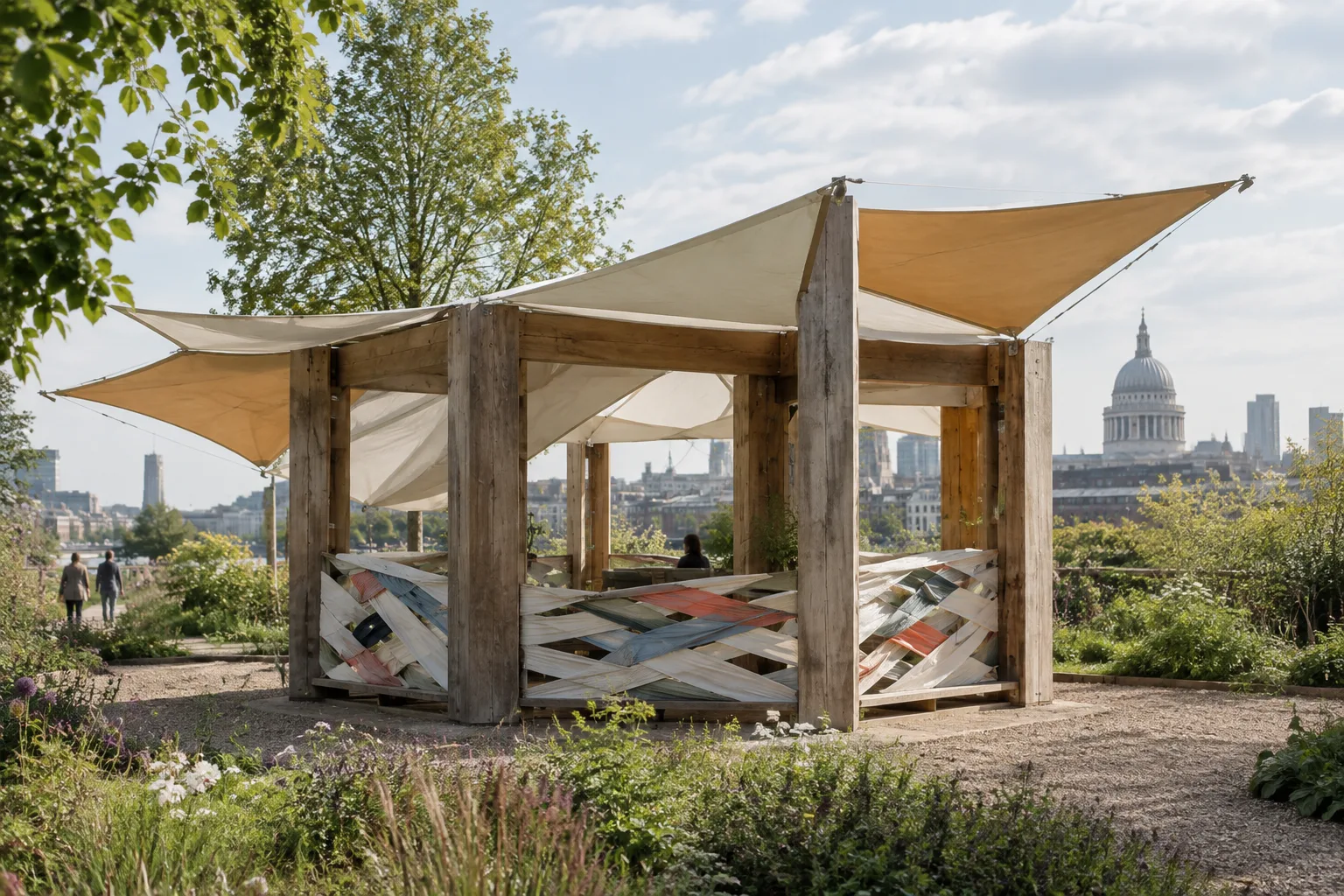
PEARCE+ installed the Guerrilla Shading Pavilion at Camden Collective in London, working with Shade the UK and local volunteers. Commissioned by Camden Town Unlimited and Euston Town BIDs for the Camden Inspire festival, the project was brought to attention by information published on 9 November 2026. Designed to be dismantled and reassembled at different times, the structure is conceived as a portable pavilion that provides shade in public spaces.
A portable frame made from five prefabricated panels
The pavilion’s main frame consists of five prefabricated panels sized to fit inside a standard transit van. The structural timber was salvaged and reused from previous PEARCE+ installations. The frame’s tapered profile is designed to accommodate wind loads transferred to the structure by the canopies, which extend outward in a cantilevered form.
The lower part of the frame does not form a closed surface. Visitors can hand-weave reclaimed hot-air balloon fabric, supplied by Cameron Hot Air Balloons and Inflate Studio, into this section to create an enclosure. This material is used in the lower part of the frame, separately from the canopies.
Naturally dyed canvas canopies
Naturally dyed canvas canopies extend outward from the main frame, expanding the shaded area in the garden around the pavilion. The canopies were developed with artist Auda Sakho. The project team also includes Shade the UK and local volunteers who took part in the build, alongside PEARCE+.
Project information lists Owen Pearce as lead architect. The design team comprises Owen Hughes Pearce, Ken Pearce, Sam Bray, Charlotte Martin, Hannah Innes and Tim Lyddon. Structural engineering was undertaken by Root Workshop and Momentum Structural Engineers, while materials were donated by Cameron Balloons and Inflate Studio.
An open-source guide accompanying the pavilion
Rather than being designed as a structure that would be left unused after a single event, the pavilion was conceived as shade infrastructure that can be reassembled at different times. However, the project information does not specify the structure’s overall dimensions, installation time, cost or the equipment required for reassembly. No details have been shared about how it could be used at other sites.
Camden Inspire and PEARCE+ also published an open-source guide titled Guerrilla Shading Our City. The guide brings together different shading approaches, from DIY external blinds and tensile canopies to urban tree planting and municipal planning permissions. Although the source describes the guide as open source, it does not provide details of its usage licence.
Implications for architecture and visualization workflows
For architecture and interior design teams working on public spaces, the project brings reusable materials, portability and user participation together in one design. Designing the panels to be transportable in a vehicle makes the logistics of temporary structures part of the design process. However, as dimensions and installation details have not been published, this information would need to be clarified before adapting a similar system to another site.
Archviz teams can show the panel arrangement, the canopies’ impact on the shaded area, and the enclosure visitors create with fabric in the lower section. The source does not mention specific software, hardware or digital fabrication methods, so no conclusions can be drawn about compatibility or hardware requirements. Teams moving toward implementation should assess material sourcing, transport and reassembly conditions, and review the licence details before using the guide.
Sources
1 sourceSource texts are not republished; short quotes are marked, everything else is our own summary and commentary.
The practical value of the Guerrilla Shading Pavilion lies in treating shade not merely as a formal design issue. Reused structural timber, portable panels and a lower section that invites visitor participation offer design decisions that offices working on temporary public structures can consider together.
For teams considering a similar project in Turkey, it would be unwise to treat this as a ready-made solution: dimensions, costs and installation requirements have not been shared. Local material availability, transport and reassembly needs should be assessed on site. The open-source guide’s usage licence should also be checked before implementation.
Frequently asked questions
Where was the Guerrilla Shading Pavilion installed?
The pavilion was installed at Camden Collective in London.
What material is used for the pavilion’s canopies?
The canopies that extend outward are made of naturally dyed canvas. Reclaimed hot-air balloon fabric is used in the lower section of the frame to create an enclosure.
What topics does the Guerrilla Shading Our City guide cover?
The open-source guide covers shading approaches such as external blinds, tensile canopies, urban tree planting and municipal planning permissions.