In brief
- Friendship Centre was built in Gaibandha, Bangladesh, between 2008 and 2011.
- The project was designed with a compacted-earth embankment to protect against flooding and primarily locally made clay bricks.
- Two blocks house offices, classrooms, a library, meditation spaces, dormitories and dining areas.
- The $200,000 prize will be shared between Kashef Chowdhury/URBANA and Fundación Gran Chaco.
According to an ArchDaily report dated 16 November 2026, the Museum of Modern Art (MoMA) has selected Kashef Chowdhury/URBANA’s Friendship Centre for the inaugural Ambasz–MoMA Annual Award for Architecture that Reconciles with Nature. The rural education and community centre in Gaibandha, Bangladesh, serves communities in the Jamuna River delta. The $200,000 prize will be shared between the architect and the nonprofit Fundación Gran Chaco, based in Argentina’s Formosa Province. On behalf of the project’s client, Friendship NGO, the foundation will plant trees in the Gran Chaco forest.
A layout shaped by flood conditions
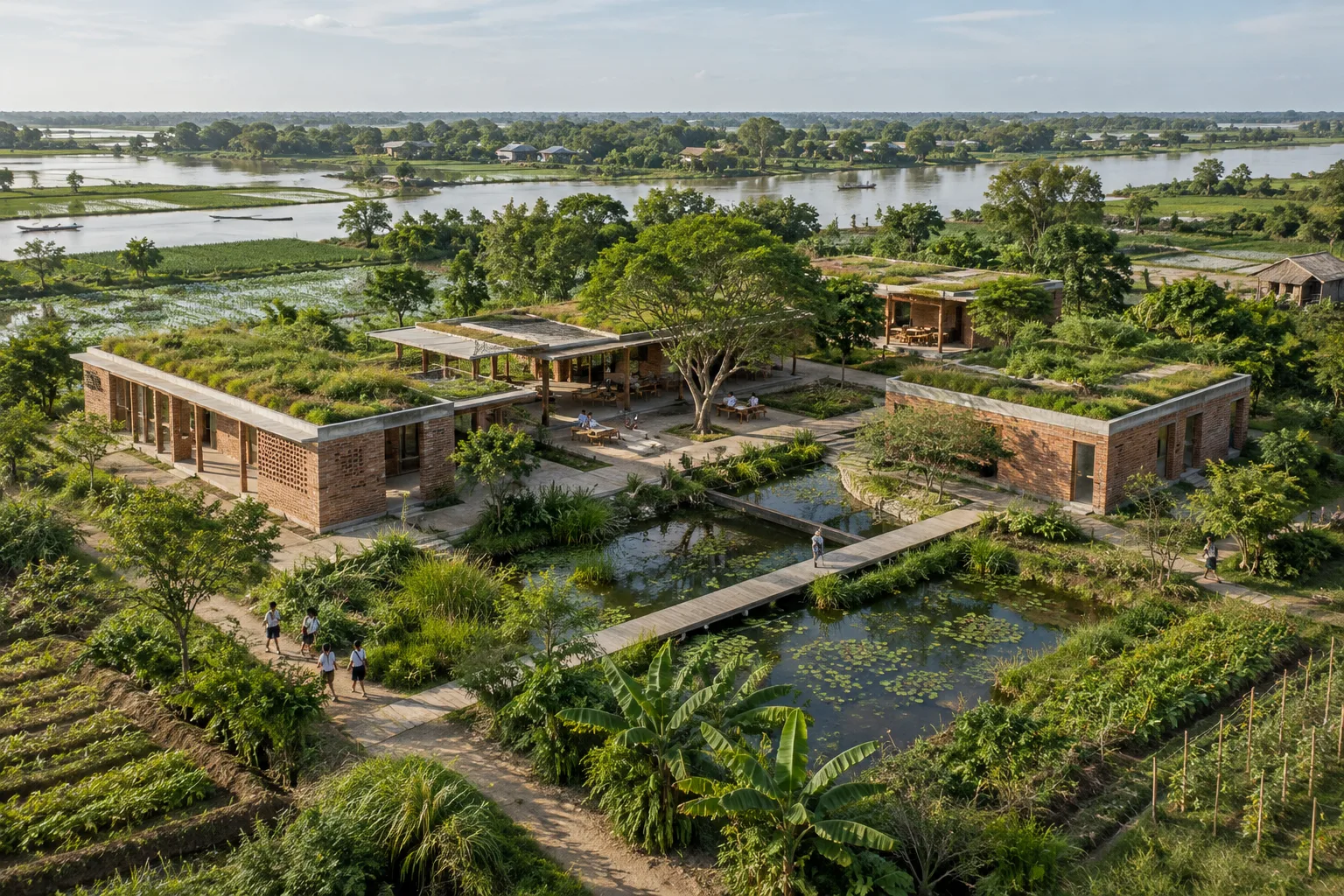
Completed between 2008 and 2011, Friendship Centre is located in an area exposed to seasonal flooding and earthquakes. Its design uses a compacted-earth embankment for flood protection, while the building itself sits on the existing ground in a lower part of the site. Construction primarily used locally made clay bricks and took the community’s building traditions into account.
The two blocks contain offices, classrooms, a library, meditation spaces, dormitories and dining areas. Green roofs, open-air courtyards and interconnected rainwater-harvesting pools are also part of the project. According to the source, these features contribute to temperature control and natural ventilation.
Friendship Centre’s layout and architectural language draw inspiration from the nearby ancient city of Mahasthangarh, which dates to the third century BCE. The project brings this historical reference together with a contemporary spatial arrangement, while also aiming to respond to the region’s water and climate conditions.
The award and selection process
MoMA describes the award as the largest prize given to a single architectural project. Projects completed anywhere in the world within the past 30 years are eligible; nominees are expected to set an example in repairing the relationship between architecture and nature. Friendship Centre was selected from a group of around 140 international projects, identified through Ambasz Institute research and nominations from 30 nominators representing different regions.
The jury included Martino Stierli, Evangelos Kotsioris and Paula Vilaplana de Miguel from MoMA’s Department of Architecture and Design, as well as Shelley McNamara of Grafton Architects and Wang Shu of Amateur Architecture Studio. The evaluation considered the coherence of the design, its creative relationship with the natural environment and its alignment with the Emilio Ambasz Institute’s mission. The award ceremony is scheduled to take place at MoMA on 12 December 2026.
Architect Kashef Chowdhury highlighted the project’s relationship with the surrounding rural landscape and the fact that the building’s mass is not prominently visible from nearby villages. As reported by the source, this is Chowdhury’s assessment of the design, not an independently stated jury criterion.
Implications for architecture and visualization workflows
Friendship Centre offers architecture and interior design teams an opportunity to examine how site, water management, materials and program can be considered together. The embankment on a flood-prone site, the layout and the rainwater-harvesting pools form the project’s environmental response. Rather than a ready-made solution to be transferred directly to another site, this approach is best understood as an example to be assessed in light of local conditions.
For visualization teams, it is also important to communicate the relationships among the two blocks, open courtyards, green roofs and water pools. In presentations, showing these elements not merely as formal details but as part of the project’s connection to its site and climate can make the design decisions easier to understand. The source does not mention any specific software, hardware, licensing or compatibility information.
Sources
1 sourceSource texts are not republished; short quotes are marked, everything else is our own summary and commentary.
Friendship Centre’s recognition shows that environmental design is not just a single technical solution: site placement, local materials, water management and user program are all parts of the same architectural approach. For offices and visualization professionals in Turkey, the project’s real value lies in offering an example of how these decisions can be presented and understood together.
This is not an announcement about a software or hardware investment, and the sources do not provide licensing or compatibility terms. Since the exact division of the prize between the parties has not been disclosed, it is best not to focus solely on the total amount when assessing its financial value. When studying the project, it is important to weigh its solutions against local climate and construction conditions.
Frequently asked questions
Which project won the Ambasz–MoMA award?
The inaugural Ambasz–MoMA Annual Award for Architecture that Reconciles with Nature went to Kashef Chowdhury/URBANA’s Friendship Centre in Bangladesh.
Where is Friendship Centre, and when was it completed?
The project is in Gaibandha, Bangladesh, and was completed between 2008 and 2011.
What is the Ambasz–MoMA award amount, and when is the ceremony?
The prize totals $200,000 and will be shared between the architect and Fundación Gran Chaco. The ceremony is scheduled to take place at MoMA on 12 December 2026.