In brief
- World Labs signed a definitive agreement to be acquired by AMD on 28 September 2026; the deal is expected to close by the end of 2026.
- Fei-Fei Li will become Senior Vice President and Chief Scientist at AMD, reporting to Lisa Su.
- Introduced on 1 September, Atlas can generate one-minute camera-controlled videos at 1440p and output Gaussian splats.
- Details about what will happen to Marble and the API platform after the acquisition have not yet been announced.
World Labs, the 3D world model company co-founded by Fei-Fei Li, announced on 28 September 2026 that it had signed a definitive agreement to be acquired by AMD. The deal is expected to close by the end of 2026, subject to regulatory approvals and customary closing conditions. The announcement came just four weeks after the company opened early access to its new “omni” world model, Atlas, on 1 September.
What are the details of the deal?
According to World Labs, Fei-Fei Li will become Executive Vice President (EVP) and Chief Scientist at AMD, reporting directly to CEO Lisa Su. Co-founders Justin Johnson and Ben Mildenhall will continue to lead the World Labs team within AMD. Ben Mildenhall is known as one of the developers of NeRF, a groundbreaking method for 3D scene representation.
The two companies had already been collaborating technically on model training and inference optimization on AMD GPUs. The announcement describes the goal as building an end-to-end, open AI ecosystem spanning hardware, software, platforms and accessible open models. The acquisition price was not disclosed.
The biggest question for users remains unanswered: the announcement mentions Marble, the API platform, Atlas and Spark, but provides no details on how these products will continue after the acquisition or whether existing customers’ services will remain uninterrupted.
What can the Atlas model do?
Introduced by World Labs on 1 September, Atlas is a model the company says was pretrained from scratch to work natively across text, images, video and 3D. Technically, it is described as a “multimodal autoregressive diffusion transformer.” Its standout capabilities include:
Camera-controlled video: Videos up to one minute long at 1440p, with pixel-level control over the camera path.
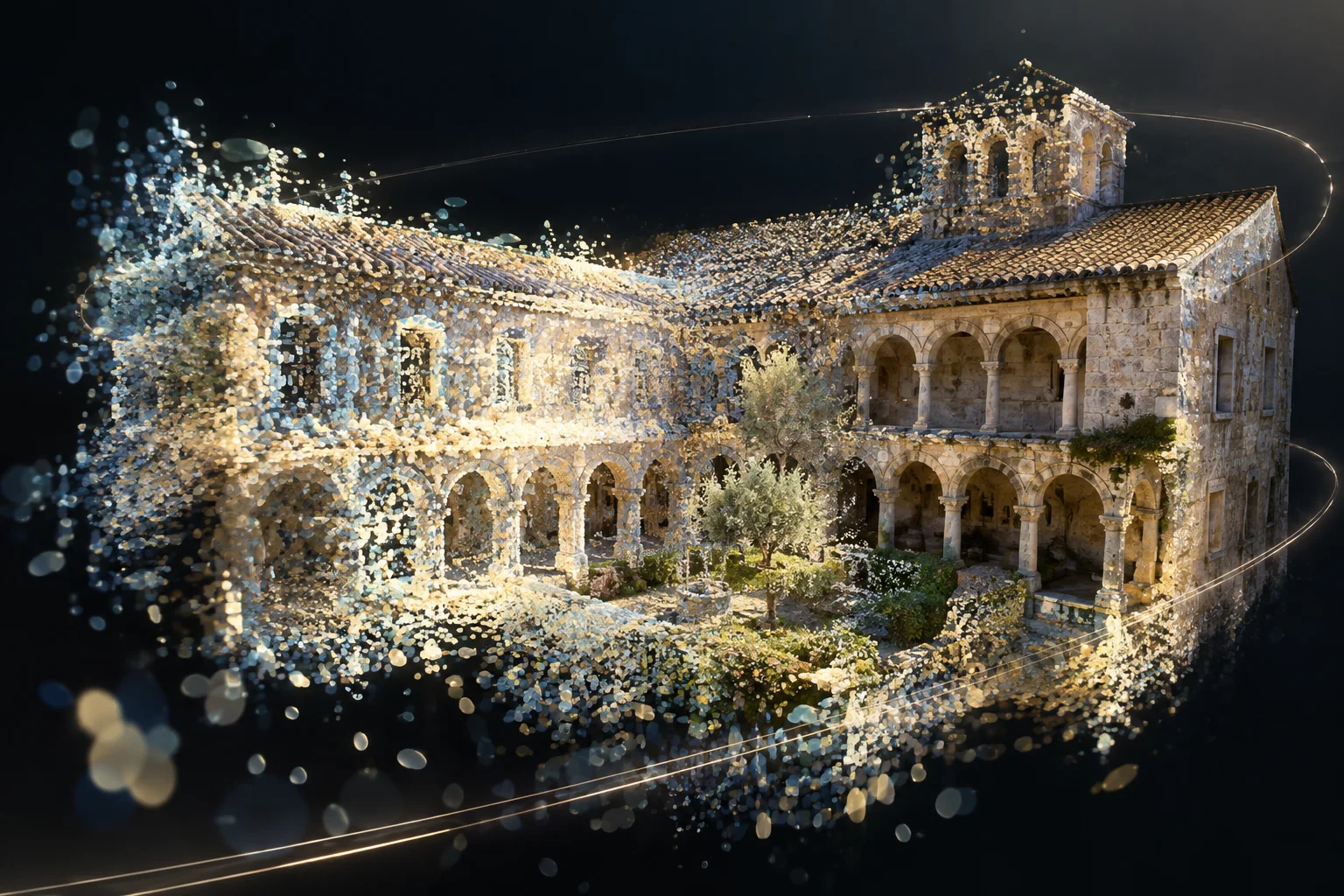
3D from sparse images: Reconstructs real scenes from a small number of photos and outputs the result as a point cloud or 3D Gaussian splat.
Images and panoramas: Generates images from text and 360-degree panoramas.
Spatiotemporal simulation: Models a scene’s spatial structure and how it changes over time, for VFX and robotics.
According to the human evaluation results shared by the company, Atlas was preferred over competing models in most camera-controlled generation tests. The company also says it achieved lower error rates than specialist models in 3D reconstruction tests. These are the company’s own evaluations; independent tests are not yet available. Atlas is currently available only to selected partners, with an application form for access. The model will power future versions of Marble. Pricing and hardware requirements have not been disclosed.
Why does this matter for architectural visualization?
World Labs’ Marble drew attention from the archviz community by generating explorable 3D worlds from text or images. Two capabilities introduced with Atlas make that interest more tangible.
The first is generating Gaussian splats from a small number of photos. Traditional photogrammetry or splat training requires dozens, or even hundreds, of photos. Getting a usable scene from just a few photos could make it much easier to quickly document an existing building, the surroundings of a site or the “before” state of a renovation project. Of course, this kind of reconstruction is no substitute for a measured survey where dimensional accuracy is required; it is better suited to visual context and presentations.
The second is long-form, camera-controlled video. In architectural presentations, the camera’s route is part of the design. A one-minute 1440p video with a defined camera path directly addresses the control problem, one of the biggest shortcomings of video models in archviz.
What could AMD’s acquisition change?
The acquisition means World Labs’ models can be more closely optimized for AMD hardware and software. The emphasis on an “open ecosystem” and “accessible open models” is notable; it could point to some models becoming more widely available in the future. However, no concrete plan in that direction has been announced. Until the product roadmap becomes clearer, the most cautious approach for Marble users is to follow developments and keep copies of their project outputs in their own archives.
The acquisition also reflects a broader industry trend: 3D scene generation and Gaussian splatting are now strategic areas of interest not only for research labs, but also for major hardware manufacturers. According to AI Weekly, Autodesk was among World Labs’ strategic backers; how that relationship with the design software sector will continue is another point to watch.
In the short term, the key factors will be when Atlas makes its way into Marble and how pricing is set. Once those details are clear, it will be easier to assess whether the model is genuinely useful for architectural presentations and context visualization. Until then, Atlas remains a technology for archviz teams to watch closely, but one they cannot yet get their hands on.
Sources
3 sourcesSource texts are not republished; short quotes are marked, everything else is our own summary and commentary.
World Labs was one of the startups working closest to archviz in 3D world generation and Gaussian splatting. AMD’s acquisition means the technology will move into a hardware manufacturer’s ecosystem. The emphasis on an open ecosystem is encouraging, but there is no concrete commitment yet for current Marble users.
For visualization teams in Turkey, Atlas’s ability to build a scene from a few photos could be useful for documenting existing conditions in renovation projects or adding contextual surroundings to a presentation. Still, the model is currently available only to selected partners, and the performance results shared so far come from the company’s own evaluations. It would be premature to plan workflows around the model before independent tests and pricing information are available.
Frequently asked questions
When is AMD acquiring World Labs?
The agreement was announced on 28 September 2026. The deal is expected to close by the end of 2026, subject to regulatory approvals.
What is World Labs’ Atlas?
Atlas is a world model trained from scratch to work across text, images, video and 3D. It can generate one-minute, camera-controlled videos at 1440p and build 3D scenes from a small number of photos as point clouds or Gaussian splats.
Who can use Atlas?
Atlas is currently available only to selected partners through early access. The World Labs website has an application form for access; pricing has not been announced.