In brief
- Doha Pavilion was realized at MIA Park in collaboration between Gerhard Richter and Selldorf Architects.
- The patterns on the structure’s six exterior walls are derived from Richter’s 1990 work Abstract Painting (724-4).
- At the pavilion’s center is STRIP-TOWER (2026), designed by the artist for this project.
- The opening coincides with the first edition of Rubaiya Qatar 2026, running from 21 November 2026 to 30 April 2027.
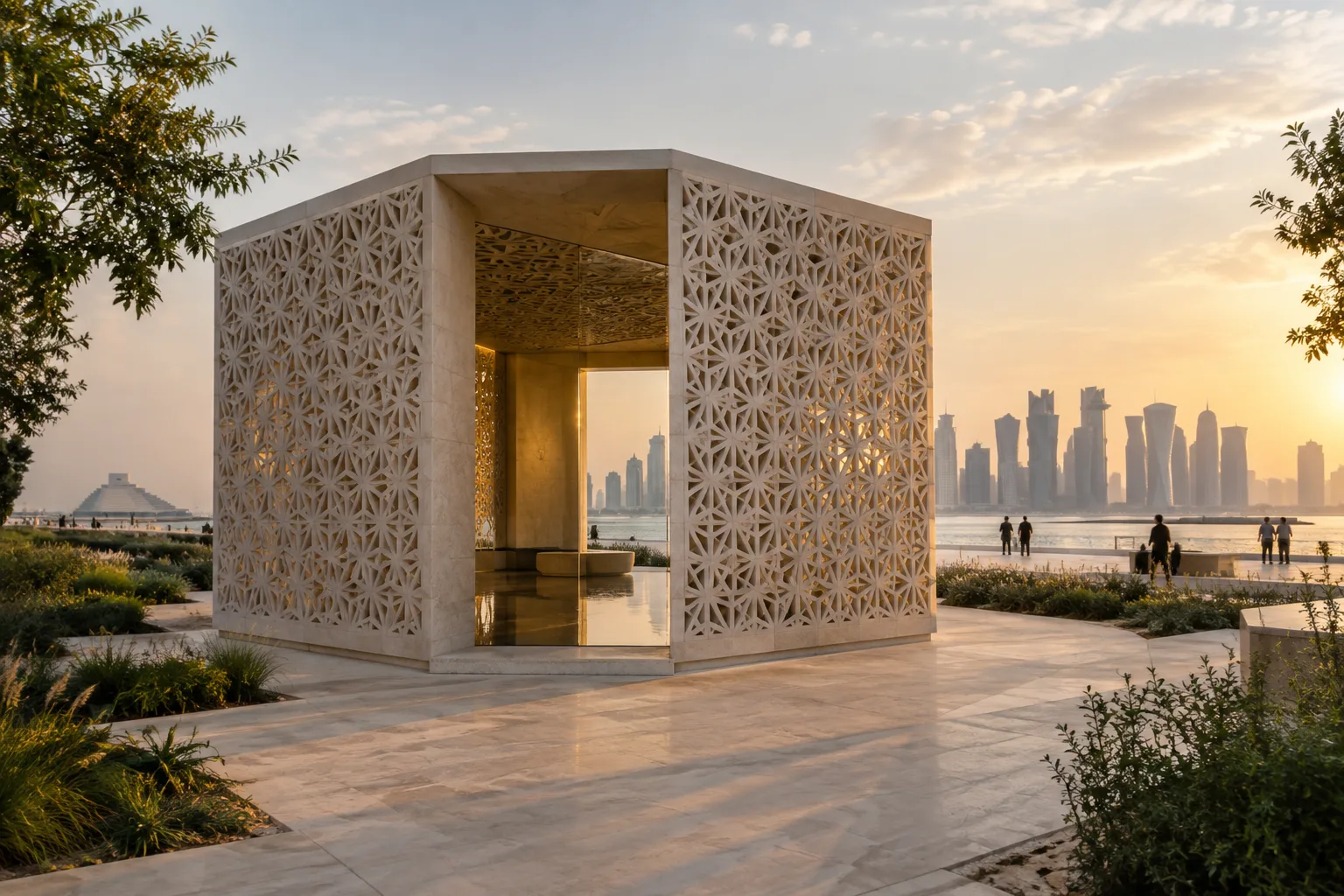
Designed in collaboration between Gerhard Richter and Selldorf Architects, Doha Pavilion: Gerhard Richter opened to visitors at MIA Park in Qatar’s capital, Doha, on 23 November 2026. Located in the park outside the Museum of Islamic Art, the hexagonal structure displays Richter’s paintings and sculptures while turning the artist’s explorations of abstraction and repetition into a spatial experience. The source identifies Qatar Museums as the project’s client and institution.
From painting to façade pattern
The patterns on the pavilion’s six exterior walls were developed from Richter’s 1990 painting Abstract Painting (724-4). During a process that began in 2010, the artist digitally divided the work into increasingly fine vertical strips, eventually reaching 8,192 segments. Mirroring and repeating the strips produced symmetrical horizontal compositions, which were transferred to the building’s exterior surfaces.
This design approach rearranges fragments of a single painting to create a new visual whole. The repeated façade motifs draw a connection to the geometric patterns and interlaced arabesques of Islamic art. In this way, the pavilion becomes a permanent public artwork that brings Richter’s exploration of abstraction into dialogue with the region’s visual traditions.
Strips, mirrors and sculpture inside
Inside the pavilion, three new large-scale works from Richter’s Strip series, which began in 2011, are on display. These works are made by converting an abstract painting into fine horizontal slices, each 0.08 millimeters wide. Their compositions, built on the repetition of color fragments, bring the artist’s paintings into the visual arrangement of the space.
At the center of the structure stands STRIP-TOWER (2026), a freestanding, three-part sculpture designed by Richter for this project. Two large mirrors from a body of work the artist began in the 1980s extend from ceiling to floor on the narrower walls. Reflecting the artworks and visitors, the mirrors transform the visual relationships within the interior. Outside the building, the stone sculpture Brunnen (Well) extends the art installation into the park.
A connection to Doha and public use
Richter’s idea for the pavilion emerged during a visit to Doha in 2013. The project was realized as part of the legacy of Qatar-Germany 2017 Year of Culture. Its opening coincides with Qatar Creates’ Fall/Winter 2026–27 program and the first edition of Rubaiya Qatar 2026, which began on 21 November 2026. The international visual arts event runs until 30 April 2027.
The pavilion joins the public art landscape at MIA Park, which also features works by Richard Serra, Nairy Baghramian, and Peter Fischli and David Weiss. Visitors encounter Richter’s visual language not only through the works inside, but also through the building’s exterior and reflective interior.
What it means for architecture and visualization teams
Doha Pavilion offers an example of treating an artwork not merely as content displayed inside a building, but as a design input that shapes its form and surface language. For architects, interior designers, and visualization teams working with repetition, scale, symmetry, and reflection, the project shows how a two-dimensional visual language can be carried onto a façade and translated into a spatial experience.
The source does not specify the building’s dimensions, façade materials, or fabrication methods. As a result, it is not possible to derive a direct implementation guide from the project. For design teams, the key takeaway is how collaboration between the artist and architectural team shaped design decisions ranging from the building’s exterior appearance to the perception of its interior.
Sources
1 sourceSource texts are not republished; short quotes are marked, everything else is our own summary and commentary.
Doha Pavilion’s strength lies in not treating the artworks as objects displayed only indoors. Bringing a pattern derived from Richter’s paintings onto the façade, and integrating mirrors and sculpture into the spatial experience, shows how art and architectural design can come together in the same project decisions.
For offices and visualization teams in Turkey, this is a valuable example to consider when developing concepts and thinking about surface language. However, because the source does not provide material, dimension, or construction details, it would not be right to treat the project as a technical construction guide. Similar projects should also account for buildability and maintenance, alongside the visual concept.
Frequently asked questions
Where is Doha Pavilion located?
The pavilion is in MIA Park in Qatar’s capital, Doha, outside the Museum of Islamic Art.
How were the patterns on Doha Pavilion’s façade created?
The patterns were developed by digitally dividing Gerhard Richter’s 1990 painting Abstract Painting (724-4) into strips, then mirroring and repeating those segments.
Which works are displayed inside the pavilion?
Inside are three new large-scale works from Richter’s Strip series, STRIP-TOWER (2026), and two large mirrors. The park also features the stone sculpture Brunnen (Well).