In brief
- The winning projects in the fifth cycle were selected from Bangladesh, the United Kingdom, Oman, Niger and Indonesia.
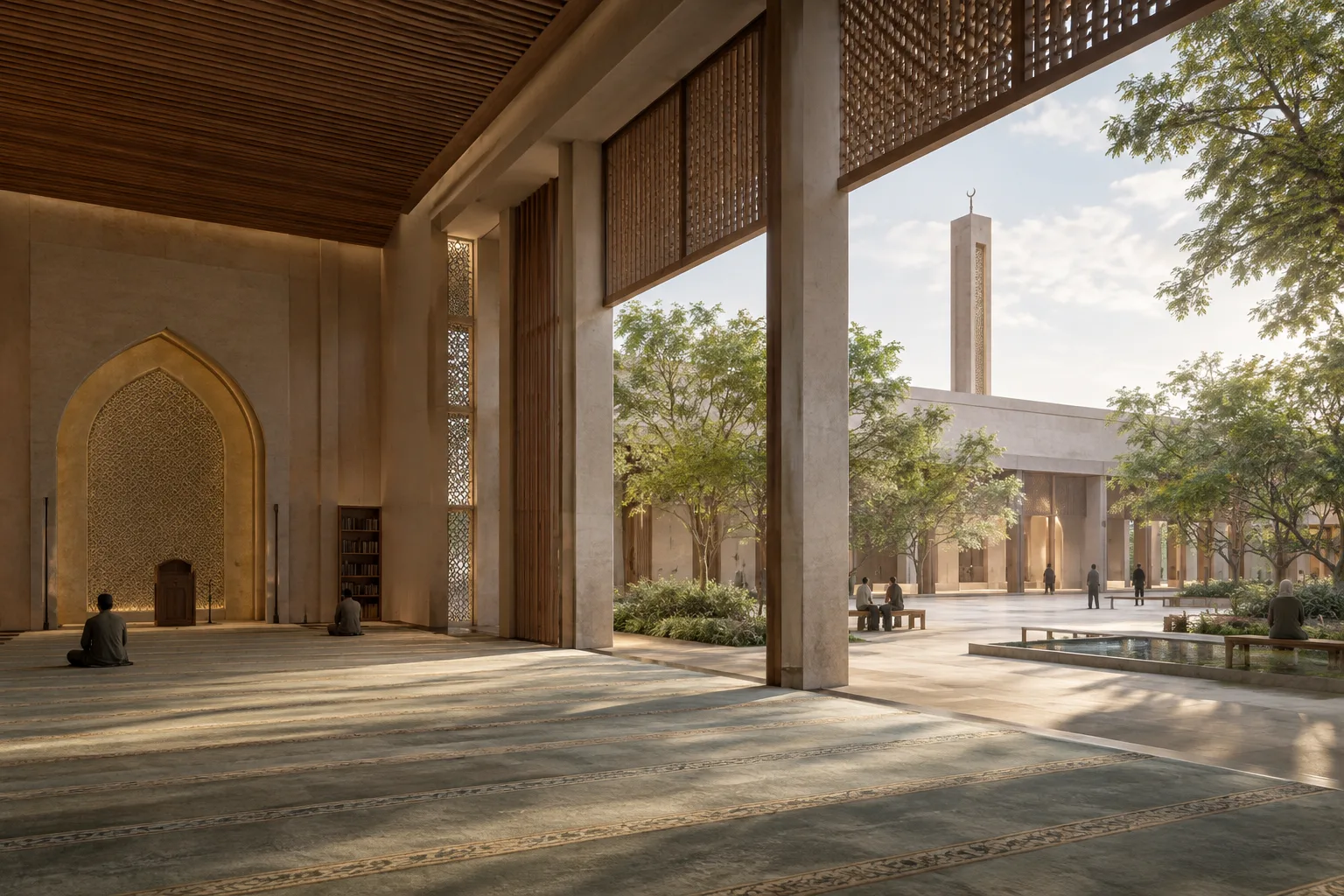
- The cycle’s theme, The Living Mosque, focuses on the mosque’s role in everyday community life.
- Hikma Community Complex in Niger was designed by Mariam Issoufou Architects and Studio Chahar.
- The Mohammed bin Salman Project for Developing Historic Mosques and the Great Mosque of Algiers received special recognition.
The Abdullatif Al Fozan Award for Mosque Architecture announced the winners of its fifth cycle (2023–2026) on 18 November 2026. Five projects from Bangladesh, the United Kingdom, Oman, Niger and Indonesia were selected for the award. The Mohammed bin Salman Project for Developing Historic Mosques in Saudi Arabia and Djamaâ El-Djazaïr, or the Great Mosque of Algiers, in Algeria were also among the projects to receive special recognition. The cycle’s theme was announced as The Living Mosque.
Projects selected from five countries
The award announcement states that the winners come from five different countries. However, the available source text does not provide the names or design details of all five projects. The project identified by name and design team is Hikma Community Complex in Niger. It was designed by Mariam Issoufou Architects and Studio Chahar.
The announcement provided does not say which projects the other four winners are or why they were selected. It is therefore not possible to compare the winners by building type, architectural approach or materials. The two projects receiving special recognition are listed separately from the five winners: the Mohammed bin Salman Project for Developing Historic Mosques in Saudi Arabia and the Great Mosque of Algiers.
The focus of The Living Mosque theme
The fifth cycle’s theme proposes that the mosque should be considered as more than a building used solely for worship. In the award’s approach, the mosque is a space that forms part of social interaction, education, cultural identity and public life. The theme aims to bring renewed attention to the connection between the building and the community’s everyday life.
The award was established in 2011. It recognizes contemporary mosque designs in terms of how they respond to the changing needs of communities and connect with architectural heritage and the principles of Islamic architecture. This approach brings traditional values together with contemporary design and construction methods. However, the source does not include details of the jury’s criteria or individual assessments of each winning project.
What it means for architecture and archviz teams
For architects and interior designers, the announcement highlights the inclusion of social interaction, education and public life in design thinking alongside the function of worship. This framework offers a basis for discussing how mosque projects relate to their communities in project presentations. However, the available information does not provide details about project plans, spatial organization, material choices or construction techniques.
Design data for all the winners has not been shared with archviz teams either. The announcement provides no information about software, hardware requirements, licensing terms or compatibility with different tools. As a result, it is not possible to recommend a specific modeling or rendering workflow based on this award announcement. Teams reviewing the projects as references should bear in mind that the announcement does not include details about the winners whose names have not been disclosed.
Sources
1 sourceSource texts are not republished; short quotes are marked, everything else is our own summary and commentary.
The Living Mosque theme invites us to think about mosque design beyond the boundaries of a place of worship, considering its relationship with community and public life. For architecture firms and visualization teams in Turkey, this approach could provide a meaningful starting point for including social and cultural functions in project narratives.
However, since the announcement gives the names of only a few winning projects and provides no technical details about any of them, it is not yet possible to compare design decisions. Before using the projects as visual or technical references, firms should verify the missing information and avoid making assumptions about hardware, software and licensing terms not covered in the announcement.
Frequently asked questions
Which countries were represented by projects selected in the fifth cycle of the Abdullatif Al Fozan Award?
Winning projects were selected from Bangladesh, the United Kingdom, Oman, Niger and Indonesia. The source text does not give the names of all five projects.
What does the theme The Living Mosque mean?
The theme presents the mosque as a space connected not only with worship, but also with social interaction, education, cultural identity and public life.
Which projects received special recognition?
The Mohammed bin Salman Project for Developing Historic Mosques and Djamaâ El-Djazaïr (the Great Mosque of Algiers) received special recognition.