In brief
- The 960 g MIRACO 2 offers six different scan modes.
- Revopoint specifies single-frame accuracy of up to 0.02 mm in Multi-Line Laser mode.
- The device has a 2 MP near-field and 50 MP far-field RGB camera.
- The limited Super Early Bird Kickstarter price starts at $1,425; the campaign announcement mentions discounts of up to 38%.
Revopoint launched its portable 3D scanner, MIRACO 2, on Kickstarter on 18 November 2026. Bringing scanning and basic data processing together in one device, the model was also presented with Revo Agents workflows intended to transfer physical data into CAD and inspection processes. These workflows are described as planned features. Limited Super Early Bird pricing starts at $1,425; the campaign announcement mentions discounts of up to 38%.
Six scan modes and on-device processing
According to information reported by 80 Level, the 960 g MIRACO 2 can handle depth calculation, point-cloud processing, scan previews, and basic editing on the device. The model features an eight-core CPU, a six-core NPU, and a six-inch 2K AMOLED touchscreen. RAM and storage options are listed as 16 GB/256 GB and 32 GB/512 GB.
The six modes are designed for objects of different sizes and levels of detail. The 34-line blue cross laser scans larger surface areas, while the 15-line parallel laser focuses on fine details. A single-line blue laser is offered for narrow gaps and recessed geometries. The other modes are Full-Field HD, VCSEL Rapid, and Hybrid HD. According to the manufacturer, Hybrid HD can capture up to 10 million points per second.
Revopoint specifies single-frame accuracy of up to 0.02 mm in Multi-Line Laser mode. The recommended minimum scan volume is 10 × 10 × 10 mm. With the optional Photogrammetric Metrology Kit, the maximum scan volume is said to reach 5 × 5 × 5 m. The company also says the device can be used on challenging subjects such as reflective metals, dark-colored objects, and the human body.
Connectivity and planned Revo Agents workflows
MIRACO 2 supports standalone use, Wi-Fi 6 for wireless PC mode, and USB-C 3.0 for a wired connection. When connected to a computer with a GPU, Multi-Line Laser scanning is reported to reach up to 120 frames per second. This speed applies to the stated computer-connected scenario; the sources do not say that a GPU-equipped computer is required for every use of the scanner. Markerless tracking of textured objects is also supported via a PC connection in laser-line modes.
Revo Agents aims to simplify tasks such as merging point clouds, generating CAD geometry from scans, and checking tolerances by comparing scan data against a reference model, using natural-language commands. The source describes these as planned workflows. It also emphasizes that human review is needed to validate CAD geometry and inspection results.
The dual RGB camera system includes a 2 MP camera for close-range captures and a 50 MP camera for larger objects and environments. When connected to a PC, the device supports physical-scale 3D Gaussian Splatting, which can export .splat models that preserve real-world dimensions. AI Segmentation is intended to remove unwanted surrounding point clouds, while AI Cropping is for selecting the scanned subject.
Its place in architecture and visualization workflows
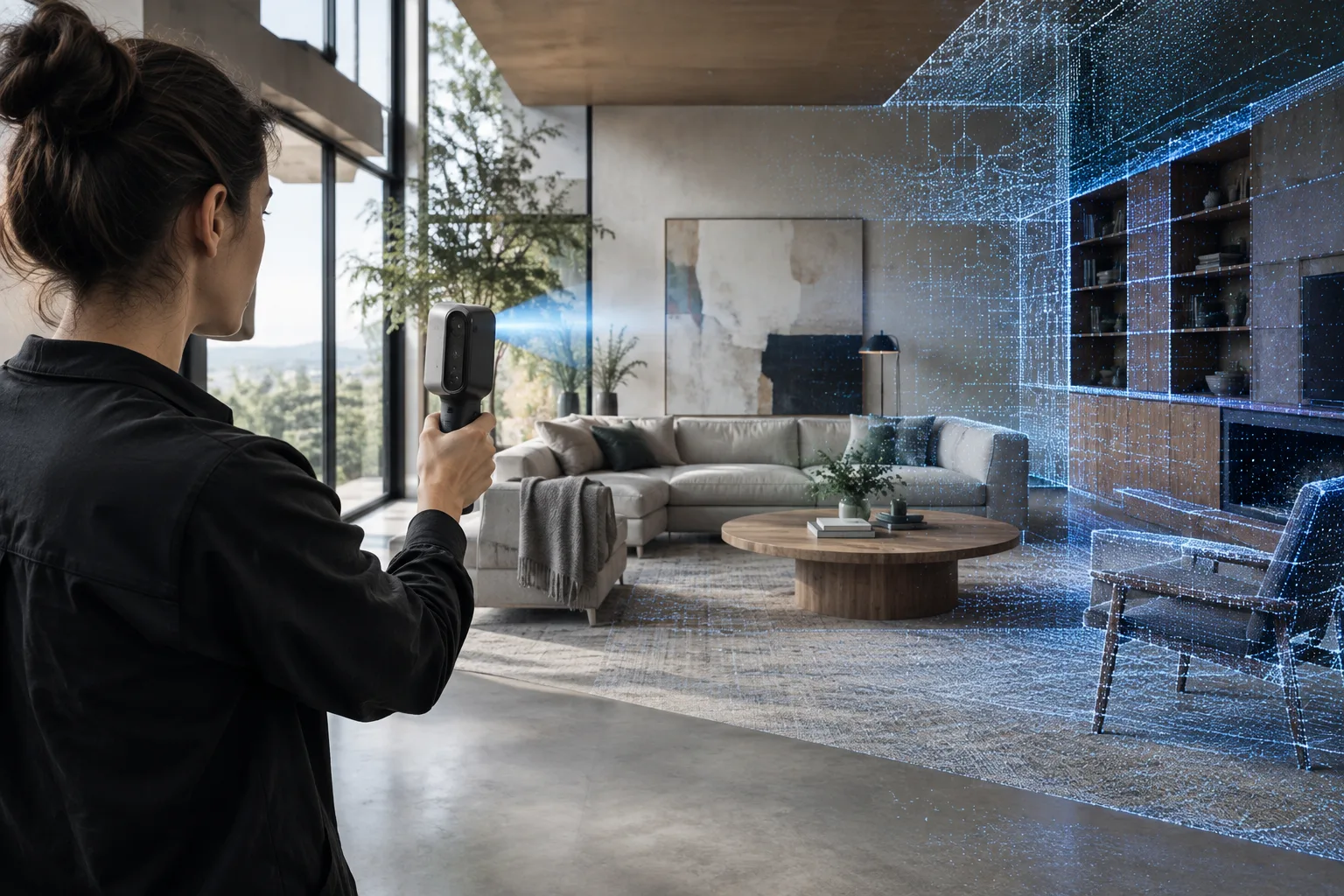
The stated use cases include transferring physical prototypes into CAD, digitally documenting spaces, and XR and visualization work. These features correspond to workflows that architecture and interior design teams may also find worth considering; however, the sources do not identify these professions as specific target users. Gaussian Splatting offers an option for visually capturing a space, while traditional mesh models remain important for tasks such as editing, animation, and simulation.
The device is designed to work indoors and outdoors under ambient lighting of up to 100,000 lux. The 10,000 mAh battery is said to provide approximately three hours of operation and support 65 W fast charging. Standalone use allows scanning without being tethered to a computer, while the reported speed of up to 120 frames per second applies to the GPU-equipped PC connection scenario. The sources provide no information about pricing in Turkey, licensing terms, or software compatibility.
Sources
2 sourcesSource texts are not republished; short quotes are marked, everything else is our own summary and commentary.
MIRACO 2’s notable feature is its attempt to bring point-cloud processing and CAD transfer together with physical data capture in a single product ecosystem. Scaled Gaussian Splatting for documenting spaces and the planned Scan-to-CAD workflow for prototypes could be interesting; however, their practical value will depend on how usable the resulting data is in real projects.
Offices in Turkey should not treat the Kickstarter price as the total cost; they should also factor in campaign terms, the optional kit, and licensing details that have not been disclosed. The high scan speed depends on a GPU-equipped PC connection, but the sources do not specify the required hardware. It is important to keep human verification as part of workflows for CAD and measurement results.
Frequently asked questions
How much does Revopoint MIRACO 2 cost on Kickstarter?
Limited Super Early Bird pricing starts at $1,425. The campaign announcement mentions discounts of up to 38%.
Which scan modes does MIRACO 2 offer?
The six modes are 34-line blue cross laser, 15-line parallel laser, single-line blue laser, Full-Field HD, VCSEL Rapid, and Hybrid HD.
Can MIRACO 2 transfer scan data into CAD?
Revo Agents plans a workflow for generating CAD geometry from scans. The source notes the importance of users validating the resulting CAD geometry.