In brief
- Bus Palladium opened as a hotel in Paris’s Pigalle district on 10 April 2026.
- The six-storey building includes 35 rooms and suites, a restaurant, bar, rooftop space and underground club.
- Rather than preserving the old building, Studio KO reinterpreted the club’s history through the façade, materials and interior details.
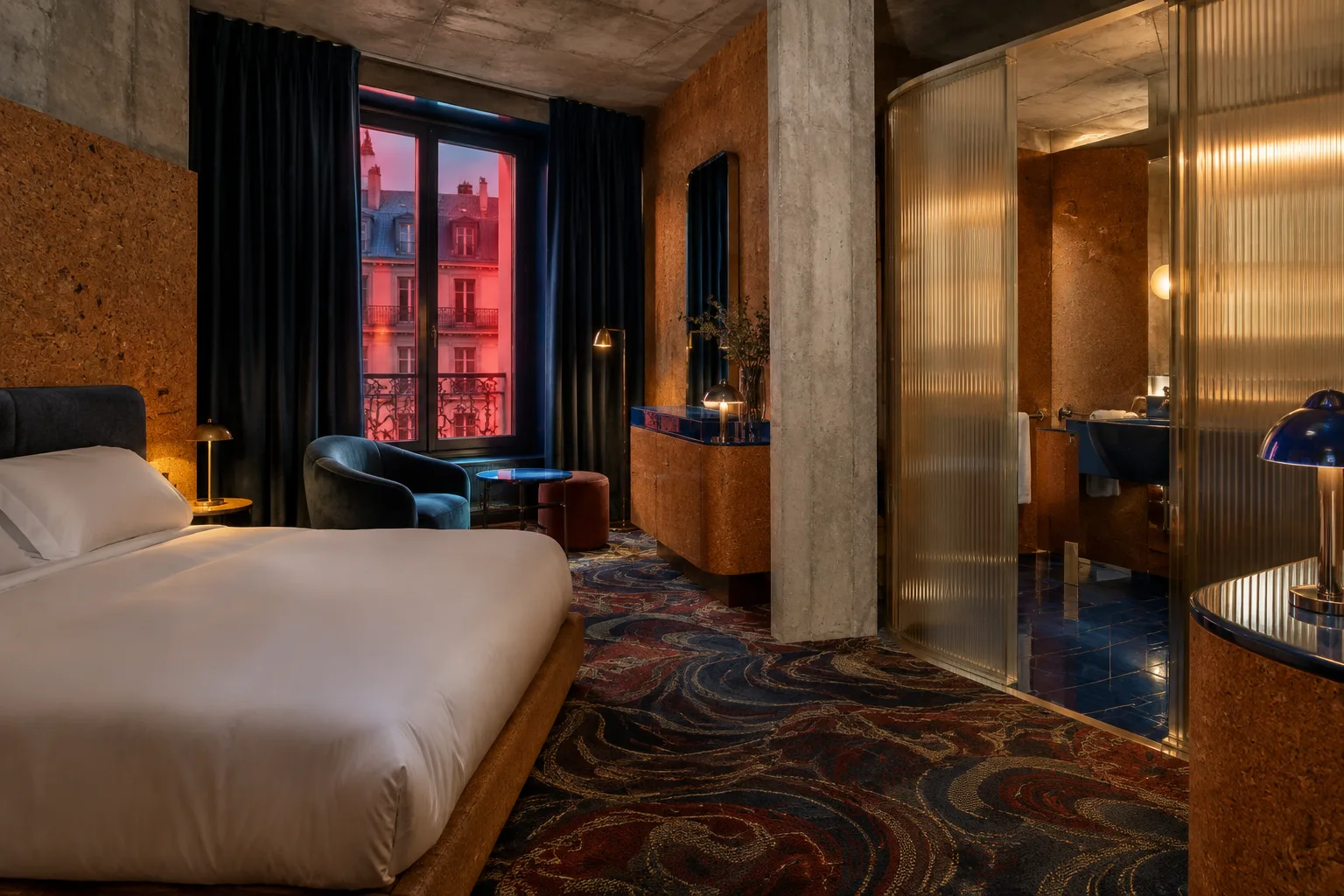
- The hotel rooms combine raw concrete, cork walls, colorful rugs and references to music culture.
The Bus Palladium hotel, designed by Studio KO, opened on 10 April 2026 in Paris’s Pigalle district. The project on Rue Pierre Fontaine gives a new purpose to the address of the nightclub founded in 1965 and closed in 2022. Rising six storeys and extending down four basement levels, the building includes 35 rooms and suites, as well as a restaurant, bar, rooftop space and club. Instead of recreating the former venue, the design carries its connection to music and nightlife into the elements of the new building.
How was the building’s past reinterpreted?
According to Designboom, the old building combined brick, stone, concrete and metal. However, it was unable to accommodate the planned renovation and extension, so it was demolished. Although Studio KO could not physically preserve the historic building, the new façade reprises the rhythm of the former entrances and horizontal lines that evoke its brick surfaces.
Sandblasted concrete was chosen for the street-facing exterior. The aggregates in the concrete mix reference the warm tones of the surrounding Haussmann-era stone buildings. The project’s underground volume was created by excavating to a depth of 14 meters. The new building thus carries traces of the past not by retaining existing walls, but through its façade composition, material choices and spatial atmosphere.
Contrasting textures and musical references indoors
The rooms’ character comes from the contrast between hard and soft surfaces in the same space. Concrete ceilings and cork-covered walls form the backdrop, while colorful rugs, mirrors and corduroy curtains bring these surfaces into a different register. Separating the bathrooms with translucent voile curtains also creates a shifting boundary between privacy and visibility.
The connection to music is woven into the form and function of objects in the rooms: keys recall vintage amplifiers, door handles evoke microphone grilles, and wooden speakers let guests listen to the hotel’s playlists. Some transparent bedside tables display artworks, cassette tapes, books and miniature buses. In the Dalí Suite, a modular De Sede DS-600 sofa, a mirrored alcove and a balcony overlooking a neon sign make the 1970s references especially clear. Art director Caroline de Maigret is also credited with contributing through music, scent and staff uniforms.
Restaurant and club programming
At the center of the restaurant is a planted area set inside a glass volume. Seating is arranged around it, while one wall is covered with more than a thousand vinyl records, including James Arch’s historic collection. The console at the record bar can be used for DJ performances, bringing the restaurant’s dining function together with its music program.
The underground club and live stage connect the former Bus Palladium’s nightlife identity to the new hotel program. Accommodation, dining and music come together at the same address. In the kitchen, chef Valentin Raffali is said to favor seasonal produce and ingredients sourced locally and directly wherever possible.
What it means for architecture and visualization teams
The project shows how architectural memory can be carried through façade lines, materials and specific objects when an existing building cannot be preserved. For architects and interior designers, the relationship between functions within the same building is worth examining, as is the way contrasting textures are brought together in the restaurant and guest rooms. Archviz teams can focus on the spatial effects of concrete, textiles, reflective surfaces and translucent partitions when visualizing this approach.
The source provides no information about the software, hardware, licensing or file compatibility used. It is therefore not possible to identify project-specific technical requirements; for similar work, teams should separately test their material and lighting choices against their own hardware and tool compatibility.
Sources
1 sourceSource texts are not republished; short quotes are marked, everything else is our own summary and commentary.
What makes Bus Palladium notable is that it tells the story of its club past through more than nostalgic objects: that story continues across different scales, from the façade composition to the vinyl archive and underground club. The contrasts in materials also make this narrative legible in the space. For interior design and visualization teams, the valuable lesson is not a prescribed style, but a way of extending the relationship between function and memory across design decisions.
For offices in Turkey, the project offers a case study in how a local past can be connected to a new program when adapting an existing building. However, the source provides no information about software, hardware, licensing or costs. The condition of the existing structure and the requirements of the selected materials should be assessed separately when making implementation decisions.
Frequently asked questions
Where is the Bus Palladium hotel, and when did it open?
The hotel opened on 10 April 2026 on Rue Pierre Fontaine in Paris’s Pigalle district.
What spaces does the Bus Palladium hotel include?
The building includes 35 rooms and suites, a restaurant, bar, rooftop space, underground club and live stage.
Did Studio KO preserve the old Bus Palladium building?
No. According to the source, the old building was demolished because it could not accommodate the planned renovation; the club’s history was reinterpreted through the new building’s façade and interior design.