In brief
- CarbonBudget is a free digital tool developed by HENN’s sustainability team.
- Calculations use details such as project location, completion year, and building area.
- The platform assesses emissions from building projects in Europe against a CO₂ budget aligned with the 1.5°C target.
- Existing LCA values can be compared, and the societal cost associated with exceeding the budget can also be calculated in monetary terms.
Architecture firm HENN announced its free CarbonBudget tool on 7 October 2026, designed to assess the CO₂ budgets of building projects in Europe. Available at carbonbudget.eu, the platform relates project details and, where available, existing life cycle assessment (LCA) values to the Paris Agreement’s 1.5°C target. Developed by HENN’s sustainability team, the tool is aimed at architects, engineers, developers, researchers, and policymakers.
What data does CarbonBudget use?
Users enter basic details for an assessment, such as the project location, completion year, and building area. The tool considers a building’s emissions in Europe against a CO₂ budget aligned with the target. If LCA values have already been calculated for the project, they can also be visualized on the platform, making it possible to assess whether emissions fall within or exceed the allocated budget.
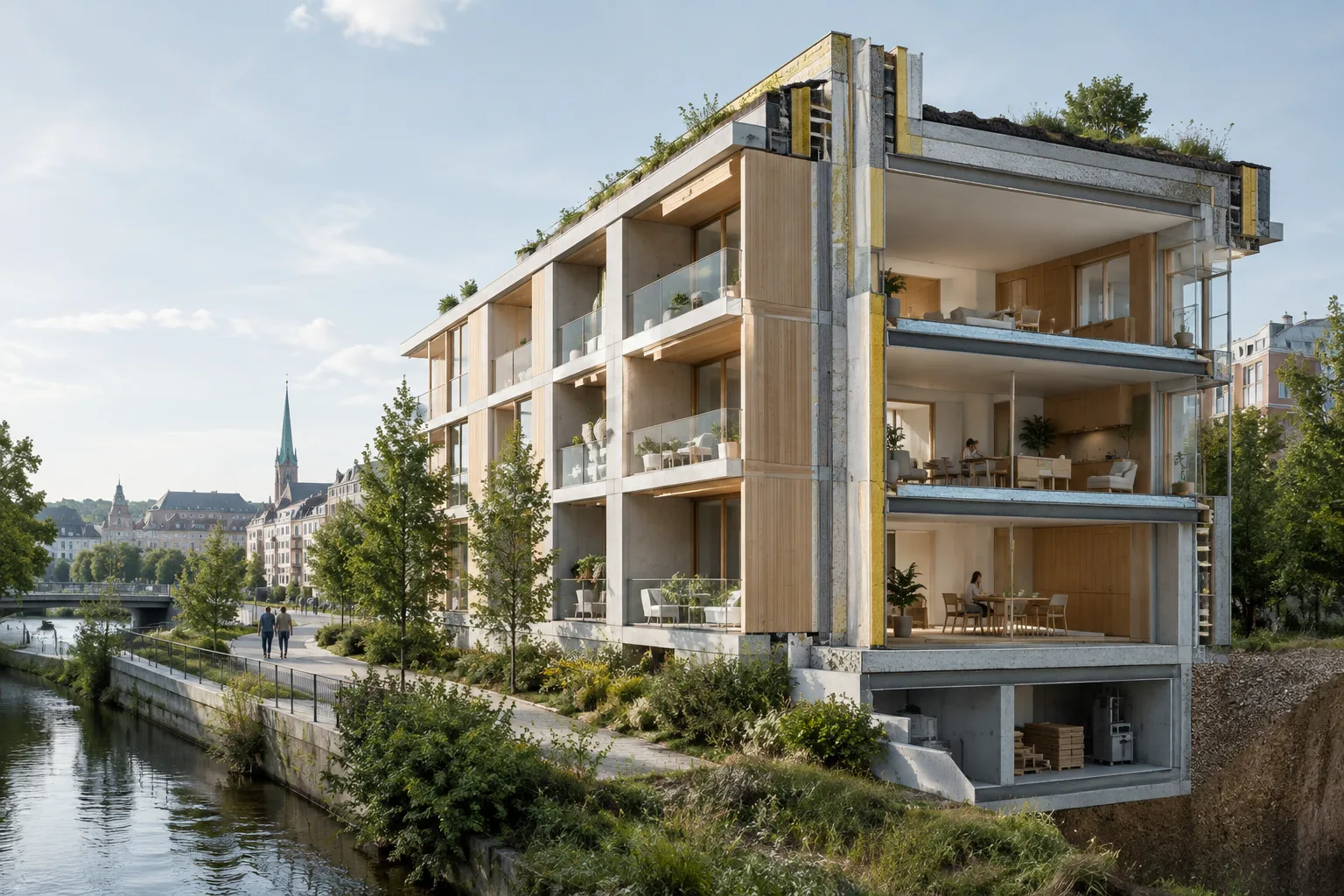
LCA considers not only a building’s impact during use, but also different stages of its life cycle. In its announcement, HENN identifies the main components of a carbon footprint as operational carbon, associated with everyday energy and water consumption, and embodied carbon, associated with materials and construction. The assessment also covers the resources used in construction, as well as the building’s operation and eventual demolition.
Putting a monetary value on exceeding the budget
CarbonBudget’s “Calculating Climate Cost” option expresses in monetary terms the societal cost that could arise if a building exceeds its allocated CO₂ budget. According to HENN, the calculation is based on values published by the German Environment Agency.
The platform draws on data from the Science Based Targets initiative (SBTi) and the Carbon Risk Real Estate Monitor (CRREM). HENN says its calculations take into account scientific decarbonization pathways and the transition of electricity grids. This means project emissions are not treated as a standalone figure, but assessed against a budget linked to a specific climate target.
Why do building type and use matter?
Different buildings have different energy needs. HENN notes that buildings with intensive technical infrastructure, such as hospitals and laboratories, may require more energy than offices. Mixed-use projects that combine several functions can also be more difficult to calculate.
For this reason, the platform’s output should not be treated as a result independent of building type and use scenario. HENN presents CarbonBudget as a framework to help users understand the potential effects of building and use decisions in the early design stages. The announcement does not provide all the technical details of the calculation method or explain the data coverage by country.
Impact on architecture, interior design, and archviz workflows
Architects and interior designers can use the tool to assess decisions such as project location, area, and function alongside a carbon budget. Teams with existing LCA data can compare those values with the budget to see how emissions relate to the target. Developers and researchers can also examine project decisions within the same framework.
For archviz teams, a potential benefit of CarbonBudget is that it may help bring data on a design’s environmental impact into project discussions; the source does not mention integration with visualization software or file-transfer support. Offices in Turkey should also examine the tool’s coverage for local projects and how its results relate to local assessment methods, since it is designed for projects in Europe. While being free makes it easier to access, the announcement provides no details about licensing terms or technical requirements.
Sources
1 sourceSource texts are not republished; short quotes are marked, everything else is our own summary and commentary.
CarbonBudget’s practical value lies in making it possible to consider carbon targets alongside project details during the design process. Being free may make it easier for teams to explore the tool at an early stage, but its results should not replace existing LCA studies or expert assessment. It is especially important to interpret outputs in the context of how a project will be used when it combines different functions.
For offices in Turkey, coverage and data sources will be key: the announcement focuses on projects in Europe and does not explain how the tool relates to local standards. Being free does not mean that licensing terms or technical compatibility are necessarily clear. Until those details are available, a more cautious approach is to treat the tool as a resource that can support decision-making.
Frequently asked questions
Is HENN CarbonBudget free?
Yes. HENN offers CarbonBudget for free at carbonbudget.eu.
What information does CarbonBudget require for a calculation?
It uses details such as the project location, completion year, and building area. Existing LCA values can also be included in the assessment.
Can CarbonBudget assess projects in Turkey?
The announcement describes the tool as designed to assess building projects in Europe. It does not explain its coverage in Turkey or how it relates to local standards.