In brief
- Hypha-Lume is a modular pavilion design with three degrees of curvature.
- The modules are designed with 20-, 40- and 60-degree curves.
- Sensors track visitors’ routes, pauses and gathering points.
- Movement data is translated into real-time light patterns and sound.
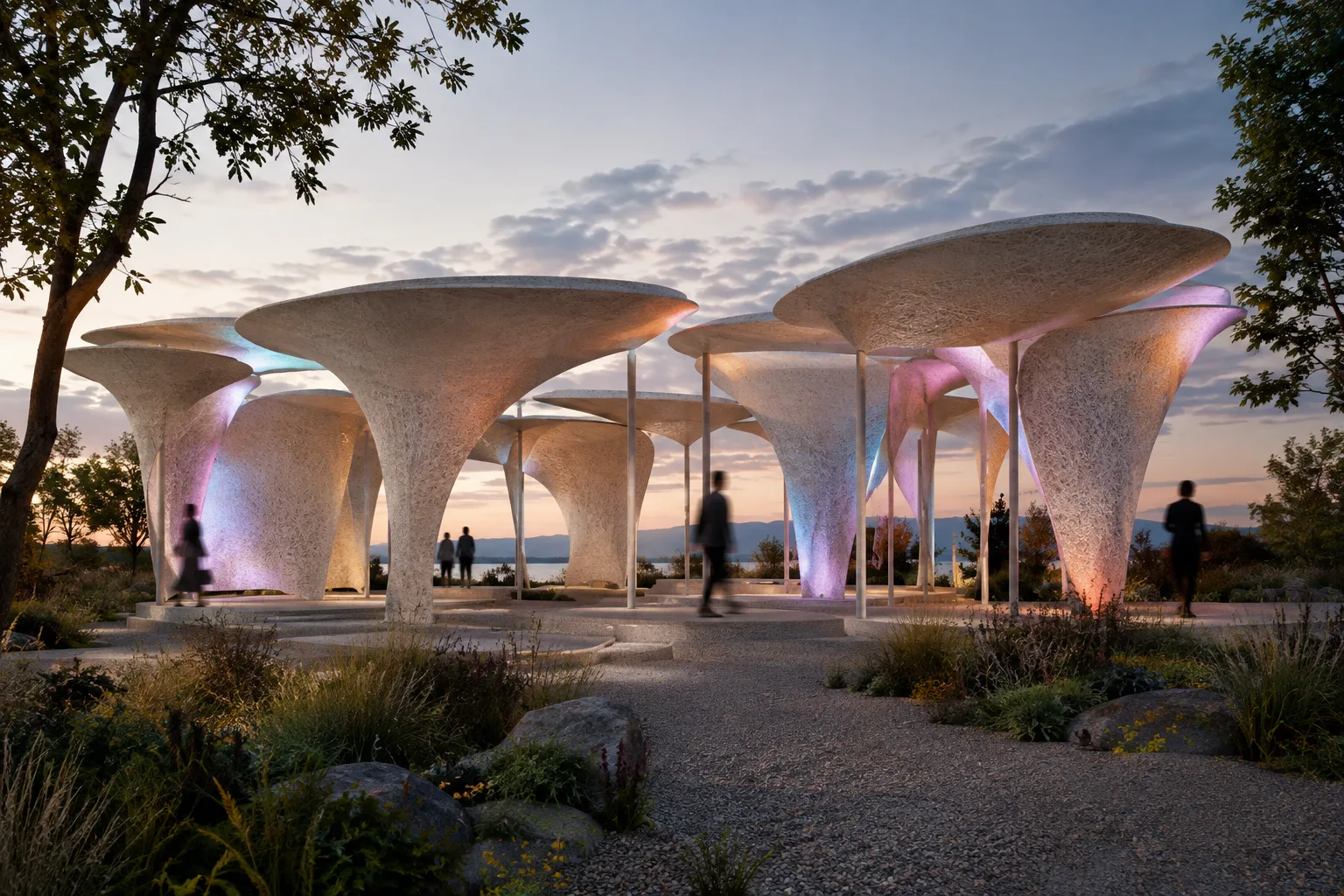
Designed by Darya Holub, Selin Ozasik, Pinak Bhapkar, Nikhil Narendiran and Baskar Bharathwaj Subramanian, Hypha-Lume was presented as a modular pavilion project that turns visitor movement into a spatial narrative element. In a 15 October 2026 report, Designboom described a design that brings together reconfigurable mycelium components, sensors, light projection and sound. The project proposes a shell system that can be reassembled to suit different spatial requirements.
A shell that changes with a limited number of modules
Hypha-Lume’s main component family consists of three module types, with curvature angles of 20, 40 and 60 degrees. These tapered pieces are joined around vertical supports to create different wall arrangements. Reassembling the modules in this way means the pavilion is not tied to a single fixed plan.
According to the project description, varying module heights and openings can accommodate different paths through the structure and lines of sight. The porous shell takes on different profiles as visitors move around it or pass through it. For daytime use, the design aims to establish a clear relationship between shelter, visibility and circulation. However, the source does not specify a particular installation site or the pavilion’s dimensions.
Connecting movement, light and sound
The pavilion’s interactive system uses sensors to detect visitors’ routes, pauses and gathering places. This movement data is translated into real-time light patterns and sound. The space is therefore defined not only by its physical form but also by how it responds to the people within it.
At night, light creates a layered visual field, projecting traces of earlier encounters onto the pavilion’s outer shell. The report says the colors change with visitors’ presence and light travels along the connections between modules. In the designers’ approach, the structure functions like an interactive archive that accumulates activity in the space; this describes the project’s design concept.
Implications for architecture and visualization workflows
Hypha-Lume offers an example of how modular geometry and visitor experience can be considered together in pavilion and temporary-space design. For architects and interior designers, its three-part module family illustrates how a limited set of components can be used to create different arrangements. Visualization teams could present the project’s daytime shell openings and nighttime light trails as separate scene conditions; these are presentation angles based on features described in the source.
However, the source does not explain which modeling software or file format was used, or provide details about the sensor hardware, technical integration or licensing terms. These elements should therefore not be assumed to be compatible with a particular 3D workflow. For a similar design, it would be important to clarify separately how the modules connect in different configurations and how sensor data is translated into light and sound. Hypha-Lume’s value lies not in offering an existing software solution, but in bringing spatial form and human movement together within a single design concept.
Sources
1 sourceSource texts are not republished; short quotes are marked, everything else is our own summary and commentary.
What stands out about Hypha-Lume for architecture and visualization teams is that it treats the modular shell as more than a formal element, linking it to visitor movement. The three curvature options provide a clear design framework for communicating different spatial arrangements. This approach could be an inspiration, particularly when presenting pavilions and experience-led spaces.
For offices in Turkey, however, production, sensor infrastructure and installation costs should be verified separately before making implementation decisions; the report does not provide this information. There are also no concrete details on hardware, software compatibility or licensing. It is therefore more accurate to view the project not as a ready-made technical solution, but as a design example that opens up discussion about the relationship between space, movement and light.
Frequently asked questions
What material is the Hypha-Lume pavilion designed with?
The project is described as a modular shell made from mycelium components. The source does not explain the material’s production method or technical properties.
How does Hypha-Lume use visitor movement?
Integrated sensors track visitors’ routes, pauses and gatherings. This data is translated into real-time light patterns and sound.
Can Hypha-Lume’s modules be rearranged?
Yes. The modules, which come in three curvature types, can be joined in different arrangements around vertical supports to create various configurations.