In brief
- The 2026 Scroll of Honour was awarded to five recipients from Brazil, Myanmar, Pakistan, Tunisia and the United Kingdom.
- Myanmar-based Housing NOW was recognized for its construction approach combining bamboo, traditional knowledge and prefabrication.
- Systems developed by Abdelmalek Ghannem in Tunisia use quarry and mining waste in building products.
- A community in Brazil was among the projects recognized for its emphasis on community participation and traditional building practices.
UN-Habitat announced the five recipients of the 2026 Scroll of Honour on 9 October 2026. Individuals and organizations from Brazil, Myanmar, Pakistan, Tunisia and the United Kingdom were recognized for their contributions to adequate housing, sustainable urbanization and urban life. Selected from 101 nominations, the recipients represent a range of approaches, from community-led construction to public housing programs.
Five award-winning approaches
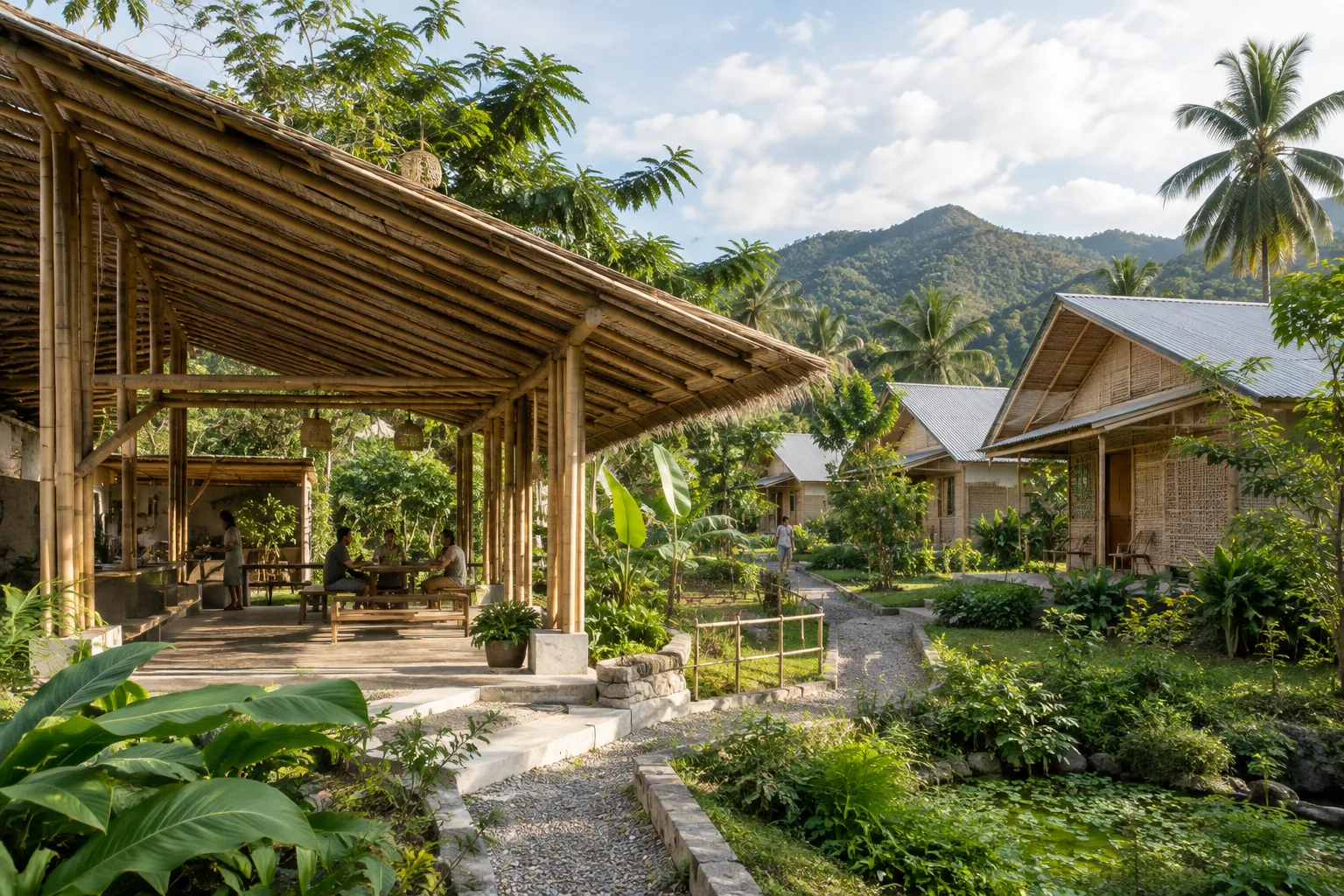
Myanmar-based Housing NOW develops affordable housing and community infrastructure using bamboo for communities affected by conflict, displacement, poverty and disasters. Its construction system combines local bamboo, traditional knowledge and prefabrication. Components are made using portable guides and assembled on site. The organization applies this approach not only to housing but also to projects such as schools, preschools, community centers and health facilities; it also provides illustrated construction guides to support local builders.
Aldeia do Espraiado – Tekoa Ara Hovy in Maricá, Brazil, provides a permanent settlement for the Guarani Mbyá community. According to the source, it is recognized as the first Indigenous village established by a municipality. Thirteen families moved into the settlement in early 2025. Alongside traditional homes, the project includes a bilingual school, a health post, a cultural center, a communal kitchen, water infrastructure and solar-powered lighting in shared areas. The settlement brings together community participation and municipal investment with traditional building practices.
Pakistan’s Punjab Housing and Town Planning Agency runs the Apni Chhat Apna Ghar program for low-income households that own land but lack the resources to build a home. Launched in 2024, the program aims to deliver 100,000 affordable houses and apartments across Punjab. Eligible households receive interest-free financing to build on their own plots, while some aspects of the application and implementation process are managed through digital systems.
In Bizerte, Tunisia, SOIB, founded by Abdelmalek Ghannem, develops building systems using local materials and industrial waste. Founded in 2009, the company’s compressed stabilized earth blocks and interlocking building systems make use of waste from quarries and mining. According to UN-Habitat, the blocks use less cement and mortar than conventional masonry; their composition can contribute to thermal performance in hot climates. The approach has reportedly been used in more than 100 building projects in Tunisia, with training provided to architects, engineers and builders. In the United Kingdom, the award went to London Mayor Sadiq Khan for his work on affordable and sustainable housing and his approach to inclusive, climate-resilient urban development. Launched in January 2026, the Key Worker Living Rent initiative aims to start construction of at least 6,000 rent-controlled homes by 2030.
What this means for architecture and housing delivery
The award-winning examples show the importance of approaches shaped by local conditions rather than a single solution to housing delivery. Housing NOW’s components, prepared using portable guides and assembled on site, offer a concrete example of how prefabrication can be applied to community infrastructure. SOIB’s blocks, which use waste materials, present an approach that considers material selection, cement and mortar use, and performance in hot climates together.
For architects and interior designers, these examples are a reminder that design decisions are not limited to a building’s form: material sourcing, local construction knowledge, user participation and financing models also affect whether housing can be delivered. However, the source provides no information on whether the systems comply with regulations or technical standards in Turkey. Teams considering similar solutions need to assess materials and implementation conditions separately for each project.
The global housing crisis behind the award
According to ArchDaily, UN-Habitat’s World Cities Report 2026 states that up to 3.4 billion people lack access to adequate housing. The organization’s SDG 11 Global Report 2026 reports that more than 1.1 billion people live in informal settlements and slums, a figure that has increased by more than 130 million since 2015. Established in 1989, the Scroll of Honour recognizes individuals and organizations working toward adequate housing, sustainable urbanization and better urban life. This year’s awards bring together responses to the issue at the scales of communities, materials, public programs and city governance.
Sources
1 sourceSource texts are not republished; short quotes are marked, everything else is our own summary and commentary.
The award’s strength from an architectural practice perspective is that it does not treat the housing crisis simply as a matter of building more homes. Prefabrication with bamboo, incorporating mining waste into building blocks, and the role of communities in design and construction offer solutions at different scales that need to be considered in relation to local conditions.
For offices in Turkey, these examples are not ready-made solutions for direct application, but starting points for design and materials research. The use of local materials and waste is especially interesting; however, cost or performance benefits should not be assumed without assessing technical suitability and implementation requirements for each project. The source provides no information on licensing, costs or regulations in Turkey.
Frequently asked questions
Who received the 2026 UN-Habitat Scroll of Honour?
The award went to Myanmar’s Housing NOW, Aldeia do Espraiado – Tekoa Ara Hovy in Brazil, Pakistan’s Punjab Housing and Town Planning Agency, Abdelmalek Ghannem of Tunisia, and London Mayor Sadiq Khan.
What construction approach earned Housing NOW recognition?
The organization develops systems that combine local bamboo, traditional knowledge and prefabrication. Components are prepared and assembled on site.
What materials does SOIB use in its building blocks?
SOIB’s compressed stabilized earth blocks and interlocking systems use local materials as well as waste from quarries and mining.