In brief
- Opaque Nanite meshes with cutout geometry were chosen instead of transparency for plants.
- Modeling and sculpting were done in Blender and ZBrush, while texturing used Substance 3D Designer and Painter.
- The team developed tools for PCG mesh scattering, moss generation with geometry scripting and trail-based scattering.
- The technical team combined instances of each mesh type into a single global HISM component across the level.
Artem Ostapchuk, senior environment artist at 11 bit studios, discussed the plant pipeline for The Alters: Last Variable DLC in an 80 Level interview published on 22 October 2026. The team aimed for the levels players encounter to work in two states: both barren and scorched, and terraformed and covered in vegetation. This dual-state design affected several stages of production, from creating and distributing environment assets to performance optimization.
How was a pipeline built for alien plants?
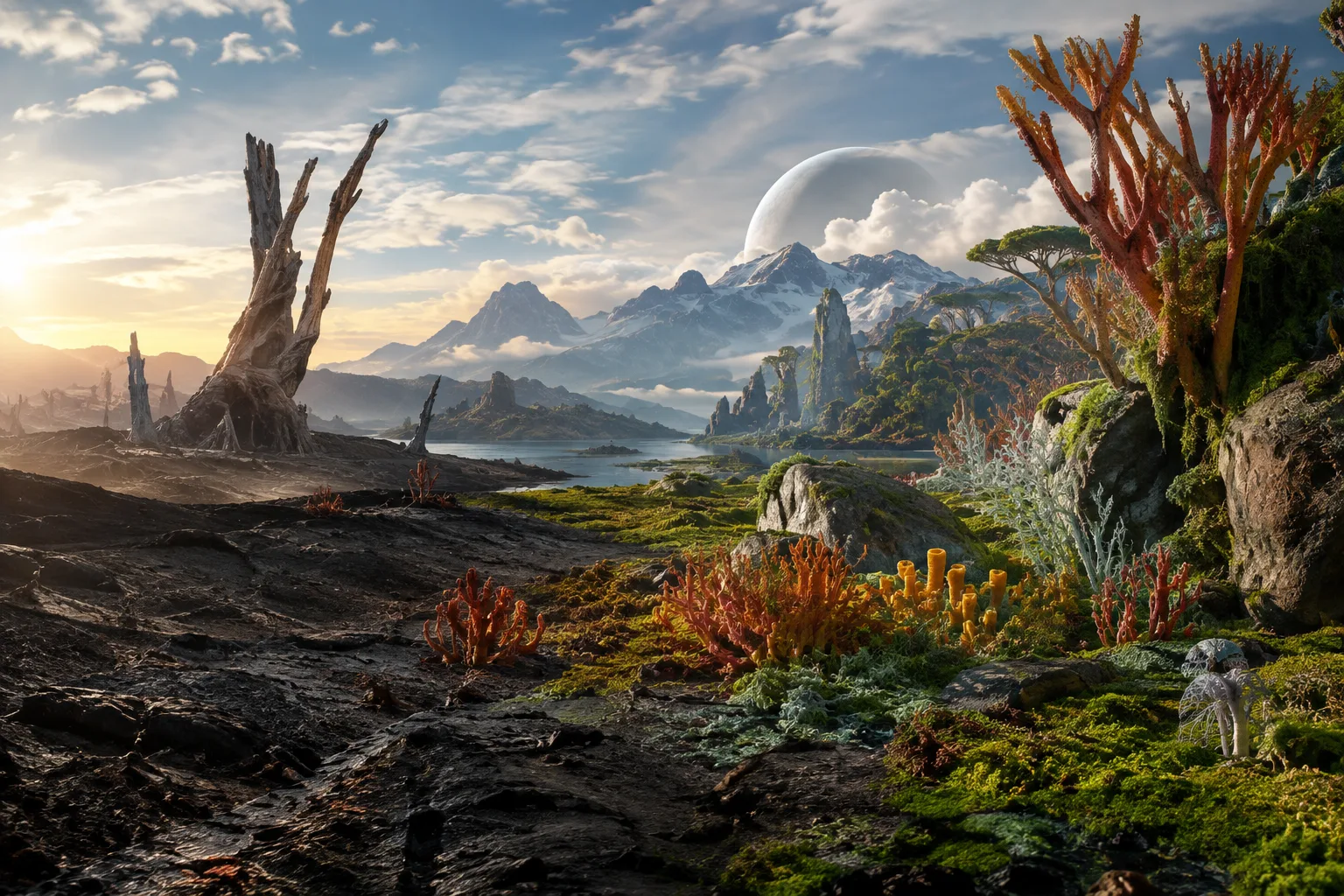
Rather than directly imitating Earth plants or relying on familiar science-fiction tropes, the art team took inspiration from fossilized trees and dead alien soil beginning to grow rapidly after being exposed to terraforming liquid. Dense layers of moss, branching forms and coral-like plants spreading across rocks and trees became key visual elements. After Robert Rejmak’s concept work, the team created a small test scene to experiment with assets, shaders and terrain transitions.
Organic forms were modeled and sculpted in Blender and ZBrush. The team used Substance 3D Designer and Substance 3D Painter for texturing, while SpeedTree or Houdini also came into the production process depending on the task. Ostapchuk said he used curve- and weight-based methods in Blender Geometry Nodes to create plant assets. The asset set was not tied to a fixed schedule from start to finish; pieces were added as concepts and level designs evolved.
How were Nanite, PCG and global HISM used?
Opaque Nanite meshes were chosen for vegetation instead of traditional masked shaders. Leaves and grass blades were modeled as cutout geometry rather than represented with transparency. According to Ostapchuk, the team’s comparison tests showed that this approach performed better than traditional masked shaders. Some assets also received subtle World Position Offset (WPO) wind animation driven by vertex color channels. For terrain, the team used VHM/RVT instead of Nanite.
Rather than sending plants directly into Unreal through Houdini Engine or a Live Link bridge, the team distributed them across scenes using in-game tools. These included PCG mesh scattering, moss generation with geometry scripting and trail-based scattering. Level instances were also used extensively to reuse prepared pieces.
The scenes contained many Blueprint prefabs and packed level actors, resulting in numerous HISM (Hierarchical Instanced Static Mesh) components spread across different actors. The technical team developed a system to combine instances of each mesh type into a single global HISM component across the level and manage packed level actors. Ostapchuk also cautioned against creating packed levels from actors that have collision or non-uniform scale.
Implications for architectural visualization and design workflows
This example describes the production of a game environment; it does not claim that the same methods will produce the same results directly in architecture or interior design projects. However, evaluating assets, materials and terrain transitions early in a small test area is a practical idea that can be drawn from a similar production approach for visualization scenes with dense vegetation. Using tools to simplify repeated distribution tasks and reusing assets are also methods teams can test in their own projects.
The source does not provide hardware requirements, licensing terms, software compatibility details or numerical performance results. Archviz teams therefore need to test whether the tools they use fit their existing workflows and how they affect performance in their own scenes. Nanite, PCG and HISM choices should be assessed in light of project requirements.
Sources
1 sourceSource texts are not republished; short quotes are marked, everything else is our own summary and commentary.
The practical value of this interview lies in the fact that it does not treat plant design in isolation: the test scene, distribution tools and instance consolidation are all parts of the same pipeline. Teams working with dense environments can assess whether the approach fits their projects by testing it at a small scale.
For architecture firms and visualization teams in Turkey, it is better to see this not as a ready-made recipe but as a set of methods to test. The source does not provide hardware requirements, licensing terms or measured performance data. Workflow or hardware investment decisions should therefore not be made until tool compatibility and scene performance have been verified.
Frequently asked questions
Which software was used to create plants in The Alters: Last Variable?
Blender and ZBrush were used for modeling and sculpting, while Substance 3D Designer and Substance 3D Painter were used for texturing. SpeedTree and Houdini were also used depending on the task.
How was vegetation distributed across levels in the DLC?
The team developed tools for PCG mesh scattering, moss generation with geometry scripting and trail-based scattering. Level instances were also used to reuse prepared pieces.
How was Nanite used for plants in The Alters: Last Variable?
Plants were created as opaque Nanite meshes, with leaves and grass blades modeled as cutout geometry. Ostapchuk said the team’s tests showed that this approach performed better than traditional masked shaders.