In brief
- Daniel Libeskind is the 37th laureate in the architecture category of the 2026 Praemium Imperiale.
- The awards were announced simultaneously in Paris, Rome, Berlin, New York, London and Tokyo on 8 September.
- Each laureate receives 15 million yen; the ceremony will take place in Tokyo on 28 October 2026.
- The association particularly emphasized Libeskind’s design practice rooted in hand drawing.
The Japan Art Association announced the 2026 Praemium Imperiale awards simultaneously in Paris, Rome, Berlin, New York, London and Tokyo on Tuesday, 8 September. The architecture award went to Polish-born American architect Daniel Libeskind, known for the Jewish Museum Berlin and the master plan for the World Trade Center site in New York. According to the official awards website, Libeskind is the 37th laureate in this category.
This year’s other laureates were Jenny Holzer for painting, Andy Goldsworthy for sculpture, Herbert Blomstedt for music, and Cate Blanchett for theatre/film. Each laureate receives 15 million yen and a certificate of recognition; the medals will be presented at a ceremony in Tokyo on 28 October 2026. The 5 million yen Grant for Young Artists went to La Source Garouste, a French organization that runs art workshops for young people in socially, economically or educationally vulnerable circumstances. The organization was founded by artist Gérard Garouste and interior designer Élizabeth Garouste.
The award known as the “Nobel Prize of the arts”
As The Art Newspaper notes, the Praemium Imperiale—often called the “Nobel Prizes of the arts”—has been awarded since 1988 and recognizes architecture alongside painting, sculpture, music and theatre/film as an art form. The award was postponed just once, in 2020, due to the pandemic. Previous architecture laureates include Eduardo Souto de Moura, Shigeru Ban and Francis Kéré.
From music to architecture
According to the biography on the awards website, Libeskind was born on 12 May 1946 in Lodz, Poland. He emigrated to the United States as a young man and settled in the Bronx, New York. Before turning to architecture, he trained as a musician. He received an architecture degree from Cooper Union in 1970 and a postgraduate degree in architectural history and theory from the University of Essex in 1972.
After winning the competition for the Jewish Museum Berlin in 1989, he established his office in Berlin. In 2003, he moved his base to New York after being appointed master planner for the World Trade Center site. Studio Libeskind now works from New York and Berlin.
| Year | Selected project |
|---|---|
| 2001 | Jewish Museum, Berlin |
| 2007 | Royal Ontario Museum, Toronto |
| 2011 | Bundeswehr Military History Museum, Dresden |
| 2011 | Reflections at Keppel Bay, Singapore |
| 2017 | Leuphana University Forum, Lüneburg |
| 2024 | Maggie’s Centre (Royal Free), London |
What did the jury highlight?
The association says it recognized Libeskind for his emotionally powerful, distinctive architecture and its ability to evoke cultural memory. According to ArchDaily, the citation highlighted the architect’s lifelong engagement with music, philosophy and literature; his sensitivity to sound and bodily experience; his approach to balancing risk with respect for history; and his sustained commitment to design rooted in hand drawing. A quote from Libeskind on the awards website sums up this approach: “Architecture, like music, is connected to the body itself.” He has previously received the Goethe Medal, the Hiroshima Art Prize, the Dresden Peace Prize and the European Sinti and Roma Civil Rights Award.
The association also cited the Albert Einstein Discovery Center project, currently underway in Ulm, and Libeskind’s 2018 book, “Edge of Order,” in which he discusses his design philosophy. The studio’s current projects include a redevelopment in Daechi-dong, in Seoul’s Gangnam district, that will replace an existing complex of five blocks and 630 apartments with six towers of up to 49 storeys and around 1,000 homes (with HJ Design Partners and SAMOO Architects & Engineers); a mixed-use building of more than 20,000 m² near the future Line 15 station of the Grand Paris Express in Issy-les-Moulineaux, near Paris, featuring green walls and bio-based materials; and the renovation of the Art Deco Boerentoren tower in Antwerp.
The place of hand drawing in the digital age
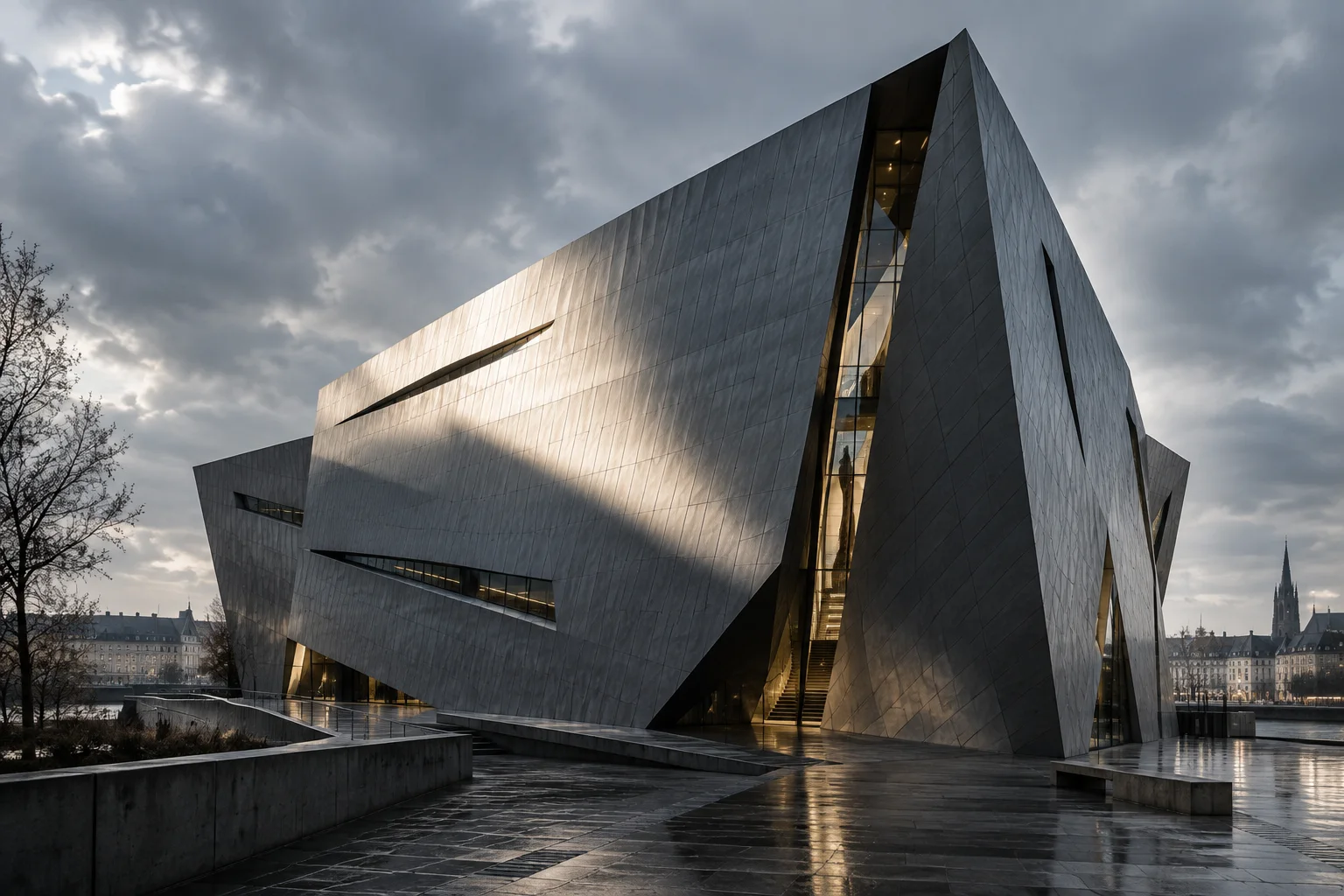
Libeskind’s sharply angled, fragmented volumes might at first seem to have emerged entirely from digital modeling. It is striking, then, that the award citation also emphasized his commitment to hand drawing. It is a reminder that even complex geometries can begin with a pencil—as an idea and a rhythm—with digital tools serving as a second layer that makes the idea buildable. At a time when AI-assisted image generation is rapidly entering the earliest stages of design, it is also worth noting that an international award citation explicitly recognized hand drawing.
For visualization artists, Libeskind’s buildings are examples where camera angle and light direction directly shape the narrative, thanks to their sharp contrasts of light and shadow and their narrow, soaring voids. In buildings such as the Jewish Museum, the effect of the space depends on where and how much light enters. This shows why lighting should be treated as a design decision in a presentation. In short, a successful image of these buildings should aim to convey an emotion rather than simply show the form.
Sources
3 sourcesSource texts are not republished; short quotes are marked, everything else is our own summary and commentary.
The award for Libeskind reflects the priorities of the Praemium Imperiale, which positions architecture as an art form: cultural memory, commemoration and emotional impact. Given how often competitions in Turkey feature monuments, museums and memorial spaces, this approach to shaping the emotional narrative of a space offers a rich field of study for students.
The citation’s emphasis on hand drawing is also an important reminder at a time when AI and parametric tools are spreading rapidly. As it becomes more common for our offices to start the ideation stage directly in software, we should remember that the sketchbook remains the fastest tool for thinking. Digital tools develop and test an idea; they don’t create the idea itself. That still begins at the architect’s desk, often at the tip of a pencil.
Frequently asked questions
Who awards the Praemium Imperiale?
Since 1988, the Japan Art Association has awarded the prize in architecture, painting, sculpture, music and theatre/film.
How much will Libeskind receive, and when is the ceremony?
Each laureate receives 15 million yen. The medals will be presented at a ceremony in Tokyo on 28 October 2026.
What are Libeskind’s best-known projects?
The Jewish Museum Berlin (2001), the Royal Ontario Museum in Toronto (2007), the Military History Museum in Dresden (2011) and the master plan for the World Trade Center site in New York are among his best-known works.