In brief
- The card is built around the Navi 48 GPU, which uses AMD’s RDNA 4 architecture.
- It offers 32 GB of GDDR6 memory, 640 GB/s of bandwidth and peak matrix performance of 382.7 TFLOPS for FP8.
- The ASRock model features dual-slot blower cooling and 300 W total board power.
- ECC support is available only on Linux and must be enabled manually.
ServeTheHome published its review of the ASRock Creator Radeon AI Pro R9700 workstation graphics card on 26 October 2026. Based on AMD’s RDNA 4 architecture, the card brings together high memory capacity and matrix compute performance for AI inference in a desktop workstation form factor. The review covers the model’s hardware specifications and design; the supplied text does not include performance test results.
32 GB of memory for AI inference
At the heart of the card is the AMD Navi 48 GPU. Featuring 64 compute units and 128 AI accelerators, the chip uses 32 GB of GDDR6 memory with 640 GB/s of bandwidth. AMD’s stated peak figures are 382.7 TFLOPS for FP8 matrix operations and 47.8 TFLOPS for FP32 vector operations. These are manufacturer-reported peak figures and should not be treated as independent benchmark results showing real-world application performance.
FP8 support, introduced with RDNA 4, is aimed at AI models that use lower-precision weights. According to the review, FP6 and FP4 formats are also supported, but those operations run through FP8. The 32 GB of memory is one of the card’s standout features for local inference workloads where model weights and working data need to fit in GPU memory.
Designed for workstation cases
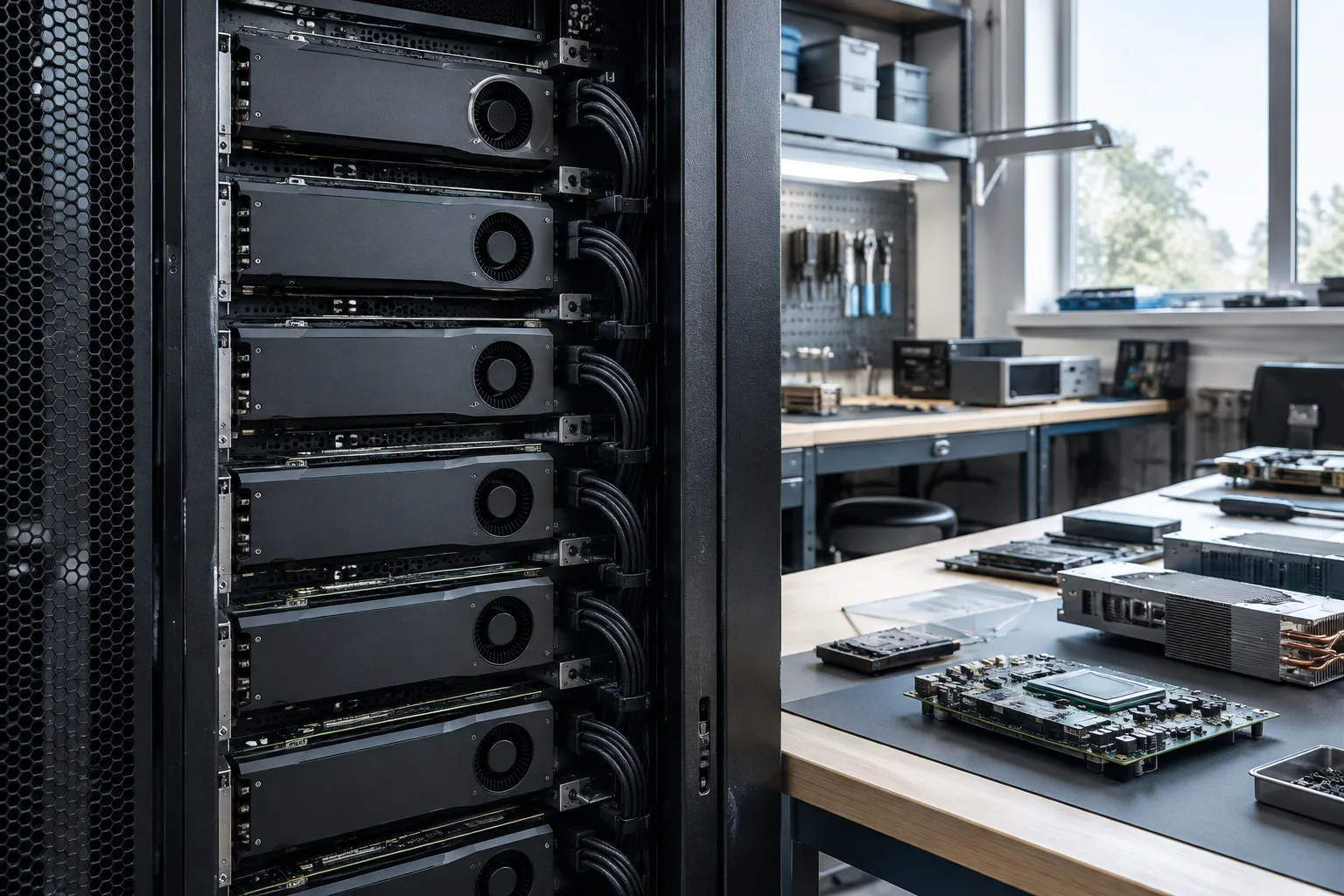
ASRock uses dual-slot blower cooling on the R9700. The card measures 271 × 111 × 39 mm and has total board power of 300 W. Its cooler features a blower that directs heat toward an outlet at the rear of the card, along with a vapor chamber that draws heat away from the GPU. The power connector is positioned at the back of the card to make multi-card configurations easier.
The model has four DisplayPort 2.1a outputs. According to the review, the card can support displays up to 12K when Display Stream Compression is used. ECC memory support is available only under Linux and must also be enabled manually. ServeTheHome mentions the possibility of installing up to four cards in standard ATX systems, though case, power supply and cooling requirements should be assessed separately for such a configuration.
Implications for architecture, interior design and visualization workflows
For architecture firms and visualization teams, a potential use for the card is running AI inference on a workstation. Its memory capacity and FP8 support are among the technical features worth considering for teams exploring local model execution. However, the source does not verify compatibility with any specific visualization software, model, driver or software setup, so support for the applications and inference tools in use should be checked separately before purchase.
The card’s dual-slot design and 300 W power draw are also important factors in system planning. Teams considering a multi-GPU setup will need to check whether the cards physically fit in the case, whether the power supply can handle the load, and whether airflow is adequate. Those seeking to use ECC will need to run Linux and enable the feature manually. The supplied review text does not disclose pricing.
Sources
1 sourceSource texts are not republished; short quotes are marked, everything else is our own summary and commentary.
The R9700’s value for architecture and visualization firms lies not only in GPU power, but also in the opportunity to use its 32 GB of memory for local inference on a single workstation. However, the source provides no real-world application tests, pricing or software compatibility details, so a purchasing decision should not be based solely on peak TFLOPS figures.
For teams in Turkey, the cost calculation should also account for power supply, case and cooling requirements. ECC support on Linux may be an advantage, but operating system and application compatibility should be verified in advance. Testing with your own models before purchase is the most reliable approach.
Frequently asked questions
How much memory does the ASRock Radeon AI Pro R9700 have?
The card has 32 GB of GDDR6 memory. Its memory bandwidth is listed as 640 GB/s.
Does the Radeon AI Pro R9700 support ECC?
Yes. ECC support is available on Linux and must be enabled manually.
How much power does the Radeon AI Pro R9700 use?
The review lists total board power at 300 W.